Ch. 20 The Heart
Martini - Fundamentals of Anatomy & Physiology 11th Edition
Martini, Nath, Bartholomew11th EditionFundamentals of Anatomy & PhysiologyISBN: 9780136874089Not the one you use?Change textbook
Chapter 20, Problem 14

What are the valves in the heart, and what is the function of each?

Verified step by step guidance
1
Identify the four main valves in the heart: the tricuspid valve, pulmonary valve, mitral (bicuspid) valve, and aortic valve.
Explain that the tricuspid valve is located between the right atrium and right ventricle, and its function is to prevent backflow of blood into the right atrium when the right ventricle contracts.
Describe the pulmonary valve, which is situated between the right ventricle and the pulmonary artery, and its role is to prevent blood from flowing back into the right ventricle after it has been pumped into the pulmonary artery.
Discuss the mitral valve, found between the left atrium and left ventricle, which prevents backflow of blood into the left atrium during left ventricular contraction.
Explain the aortic valve, located between the left ventricle and the aorta, which stops blood from returning to the left ventricle after it has been ejected into the aorta.

Verified video answer for a similar problem:

This video solution was recommended by our tutors as helpful for the problem above.
Was this helpful?

Key Concepts

Here are the essential concepts you must grasp in order to answer the question correctly.

Types of Heart Valves

The heart contains four main valves: the tricuspid, pulmonary, mitral, and aortic valves. These valves are located between the heart chambers and major blood vessels, ensuring unidirectional blood flow through the heart.
Recommended video:
Guided course
6:13
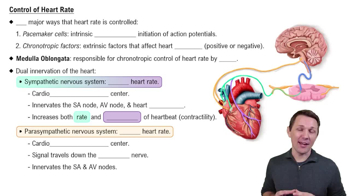
Control of Heart Rate

Function of Atrioventricular Valves

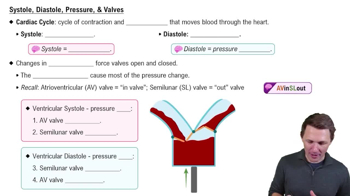
The tricuspid and mitral valves, known as atrioventricular valves, control blood flow from the atria to the ventricles. They prevent backflow of blood into the atria when the ventricles contract.
Recommended video:
Guided course
7:13
Systole, Diastole, Pressure, & Valves

Function of Semilunar Valves

The pulmonary and aortic valves, called semilunar valves, regulate blood flow from the ventricles into the pulmonary artery and aorta. They prevent blood from returning to the ventricles after contraction.
Recommended video:
Guided course
7:13
Systole, Diastole, Pressure, & Valves