Ch. 21 Blood Vessels and Circulation
Martini - Fundamentals of Anatomy & Physiology 11th Edition
Martini, Nath, Bartholomew11th EditionFundamentals of Anatomy & PhysiologyISBN: 9780136874089Not the one you use?Change textbook
Chapter 21, Problem 27

Compare the effects of the cardioacceleratory and cardioinhibitory centers on cardiac output and blood pressure.

Verified step by step guidance
1
Step 1: Understand the roles of the cardioacceleratory and cardioinhibitory centers. The cardioacceleratory center increases heart rate and contractility, while the cardioinhibitory center decreases heart rate.
Step 2: Recall that cardiac output (CO) is calculated by the formula \(CO = HR \times SV\), where \(HR\) is heart rate and \(SV\) is stroke volume. Changes in heart rate directly affect cardiac output.
Step 3: Analyze how the cardioacceleratory center affects cardiac output and blood pressure. By increasing heart rate and contractility, it increases stroke volume and cardiac output, which typically raises blood pressure.
Step 4: Analyze how the cardioinhibitory center affects cardiac output and blood pressure. By decreasing heart rate, it reduces cardiac output, which generally lowers blood pressure.
Step 5: Summarize the comparison: the cardioacceleratory center elevates cardiac output and blood pressure through sympathetic stimulation, whereas the cardioinhibitory center reduces cardiac output and blood pressure via parasympathetic stimulation.

Verified video answer for a similar problem:

This video solution was recommended by our tutors as helpful for the problem above.
Was this helpful?

Key Concepts

Here are the essential concepts you must grasp in order to answer the question correctly.

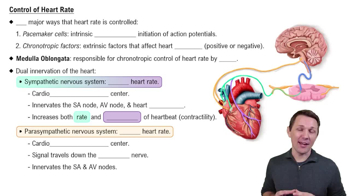
Cardioacceleratory Center

The cardioacceleratory center is a region in the medulla oblongata that increases heart rate and force of contraction by stimulating the sympathetic nervous system. This leads to an increase in cardiac output, which raises blood pressure by pumping more blood per minute through the circulatory system.
Recommended video:
Guided course
6:13
Control of Heart Rate

Cardioinhibitory Center

The cardioinhibitory center, also located in the medulla oblongata, decreases heart rate by activating the parasympathetic nervous system via the vagus nerve. This reduction in heart rate lowers cardiac output, which can decrease blood pressure by reducing the volume of blood pumped by the heart.
Recommended video:
Guided course
6:13
Control of Heart Rate

Cardiac Output and Blood Pressure Relationship

Cardiac output is the volume of blood the heart pumps per minute, directly influencing blood pressure. An increase in cardiac output raises blood pressure, while a decrease lowers it. Both the cardioacceleratory and cardioinhibitory centers regulate this balance through autonomic nervous system control.
Recommended video:
Guided course
5:46
Formalizing Pressure Relationships in the Lungs