Ch. 23 The Respiratory System
Martini - Fundamentals of Anatomy & Physiology 11th Edition
Martini, Nath, Bartholomew11th EditionFundamentals of Anatomy & PhysiologyISBN: 9780136874089Not the one you use?Change textbook
Chapter 23, Problem 22c

What is the significance of
(c) Henry's law to the process of respiration?

Verified step by step guidance
1
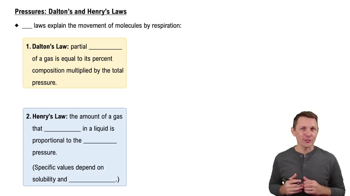
Understand the concept of Henry's law: Henry's law states that the amount of gas that dissolves in a liquid is directly proportional to the partial pressure of the gas above the liquid, provided the temperature remains constant. This principle is crucial in understanding gas exchange during respiration.
Relate Henry's law to oxygen and carbon dioxide: In the lungs, oxygen and carbon dioxide are exchanged between the alveoli and the blood. The partial pressure of oxygen in the alveoli determines how much oxygen dissolves into the blood, while the partial pressure of carbon dioxide in the blood determines how much carbon dioxide diffuses into the alveoli.
Consider the role of solubility: Henry's law also accounts for the solubility of gases. Carbon dioxide is more soluble in blood plasma than oxygen, which explains why it can be transported more efficiently in dissolved form compared to oxygen.
Apply Henry's law to gas exchange: During inhalation, the high partial pressure of oxygen in the alveoli drives oxygen into the blood. During exhalation, the high partial pressure of carbon dioxide in the blood drives carbon dioxide into the alveoli for removal from the body.
Connect Henry's law to physiological adaptations: The efficiency of gas exchange in the lungs is influenced by factors such as the partial pressures of gases, the solubility of gases, and the surface area of the alveoli. These adaptations ensure optimal oxygen uptake and carbon dioxide removal, as described by Henry's law.

Verified video answer for a similar problem:

This video solution was recommended by our tutors as helpful for the problem above.
Was this helpful?

Key Concepts

Here are the essential concepts you must grasp in order to answer the question correctly.

Henry's Law

Henry's Law states that the amount of gas that dissolves in a liquid is directly proportional to the partial pressure of that gas above the liquid. This principle is crucial in understanding how gases like oxygen and carbon dioxide are exchanged in biological systems, particularly in the lungs where blood and air interface.
Recommended video:
Guided course
5:51
Pressures: Dalton’s and Henry’s Laws

Gas Exchange in Respiration

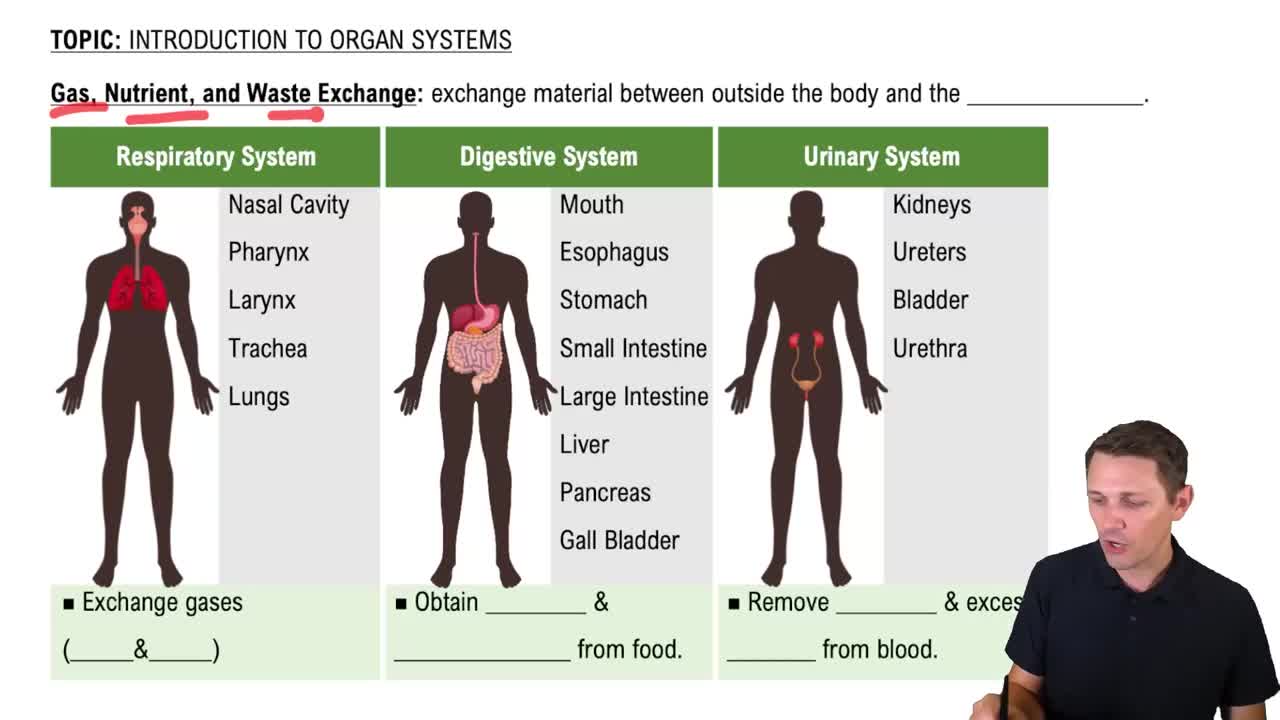
Gas exchange is the process by which oxygen is taken into the body and carbon dioxide is expelled. In the lungs, oxygen diffuses from the alveoli into the blood, while carbon dioxide moves from the blood into the alveoli, driven by differences in partial pressures, which is explained by Henry's Law.
Recommended video:
Guided course
03:59
Gas, Nutrient and Waste Exchange

Partial Pressure

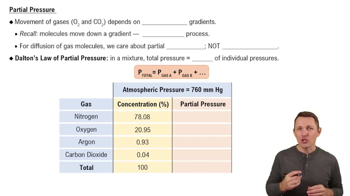
Partial pressure refers to the pressure exerted by a single type of gas in a mixture of gases. In the context of respiration, the partial pressures of oxygen and carbon dioxide in the alveoli and blood determine the direction and rate of gas diffusion, making it essential for efficient respiratory function.
Recommended video:
Guided course
6:12
Partial Pressure