Ch. 24 The Digestive System
Martini - Fundamentals of Anatomy & Physiology 11th Edition
Martini, Nath, Bartholomew11th EditionFundamentals of Anatomy & PhysiologyISBN: 9780136874089Not the one you use?Change textbook
Chapter 24, Problem 23

Increased parasympathetic stimulation of the intestine would result in
(a) Decreased motility
(b) Decreased secretion
(c) Decreased sensitivity of local reflexes
(d) Decreased segmentation
(e) None of these

Verified step by step guidance
1
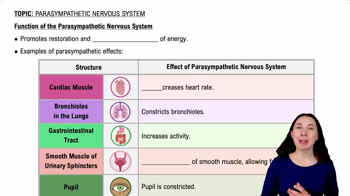
Step 1: Understand the role of the parasympathetic nervous system in the gastrointestinal (GI) tract. The parasympathetic system generally promotes 'rest and digest' activities, which include increasing motility and secretion in the intestines.
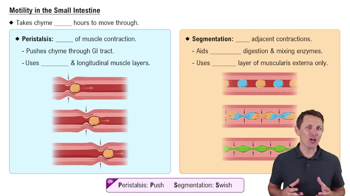
Step 2: Recall that increased parasympathetic stimulation typically enhances intestinal motility, meaning it increases the contractions that move food through the digestive tract.
Step 3: Recognize that parasympathetic stimulation also increases secretion of digestive enzymes and fluids to aid digestion, rather than decreasing it.
Step 4: Consider the effect on local reflexes and segmentation. Parasympathetic activity tends to enhance local reflexes and segmentation (mixing movements), not decrease them.
Step 5: Based on these physiological principles, conclude that increased parasympathetic stimulation would not cause any of the decreases listed in options (a) through (d), so the correct choice aligns with option (e) None of these.

Verified video answer for a similar problem:

This video solution was recommended by our tutors as helpful for the problem above.
Was this helpful?

Key Concepts

Here are the essential concepts you must grasp in order to answer the question correctly.

Parasympathetic Nervous System and Gastrointestinal Function

The parasympathetic nervous system primarily stimulates digestive activities by increasing motility and secretion in the gastrointestinal tract. It promotes processes like peristalsis and segmentation to aid digestion and nutrient absorption.
Recommended video:
1:56
Function of the Parasympathetic Nervous System

Intestinal Motility and Segmentation

Intestinal motility refers to the movements of the digestive tract that mix and propel contents. Segmentation is a type of motility involving rhythmic contractions that mix intestinal contents, enhancing digestion and absorption.
Recommended video:
Guided course
3:06
Motility in the Small Intestine

Local Reflexes in the Intestine

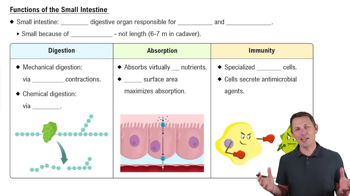
Local reflexes in the intestine are neural circuits within the enteric nervous system that regulate motility and secretion independently of the central nervous system. Parasympathetic stimulation generally enhances the sensitivity and activity of these reflexes.
Recommended video:
Guided course
3:44
Functions of the Small Intestine