Ch. 26 The Urinary System
Martini - Fundamentals of Anatomy & Physiology 11th Edition
Martini, Nath, Bartholomew11th EditionFundamentals of Anatomy & PhysiologyISBN: 9780136874089Not the one you use?Change textbook
Chapter 25, Problem 9

Trace the pathway of the protein-free filtrate from where it is produced in the renal corpuscle until it drains into the renal pelvis in the form of urine. (Use arrows to indicate the direction of flow.)

Verified step by step guidance
1
Start at the renal corpuscle, where the protein-free filtrate is produced by the process of filtration through the glomerulus into Bowman's capsule.
From Bowman's capsule, the filtrate flows into the proximal convoluted tubule, where reabsorption of water, ions, and nutrients begins.
Next, the filtrate moves into the loop of Henle, which has a descending limb and an ascending limb; here, further reabsorption of water and solutes occurs to concentrate the filtrate.
After the loop of Henle, the filtrate enters the distal convoluted tubule, where additional selective reabsorption and secretion take place to fine-tune the filtrate composition.
Finally, the filtrate drains into the collecting duct, which collects urine from multiple nephrons and transports it through the renal papilla into the minor calyx, then to the major calyx, followed by the renal pelvis, from where it flows into the ureter for excretion.

Verified video answer for a similar problem:

This video solution was recommended by our tutors as helpful for the problem above.
Was this helpful?

Key Concepts

Here are the essential concepts you must grasp in order to answer the question correctly.

Formation of Protein-Free Filtrate in the Renal Corpuscle

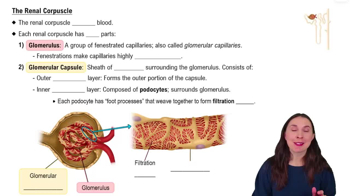
The renal corpuscle, consisting of the glomerulus and Bowman's capsule, filters blood plasma to produce protein-free filtrate. This process, called glomerular filtration, allows water and small solutes to pass while retaining larger molecules like proteins and blood cells.
Recommended video:
4:52
The Renal Corpuscle

Flow Through the Renal Tubular System

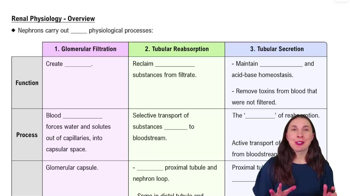
After filtration, the protein-free filtrate flows through the renal tubule segments: proximal convoluted tubule, loop of Henle, distal convoluted tubule, and collecting duct. Each segment modifies the filtrate by reabsorbing water and solutes or secreting substances, concentrating the urine.
Recommended video:
0:52
Renal Physiology Step 2: Tubular Reabsorption Example 6

Drainage into the Renal Pelvis

The final urine from collecting ducts drains into papillary ducts, then into minor calyces, major calyces, and the renal pelvis. From the renal pelvis, urine flows into the ureter for transport to the bladder, completing the excretory pathway.
Recommended video:
4:58
Overview of Renal Physiology