Ch. 29 Development and Inheritance
Martini - Fundamentals of Anatomy & Physiology 11th Edition
Martini, Nath, Bartholomew11th EditionFundamentals of Anatomy & PhysiologyISBN: 9780136874089Not the one you use?Change textbook
Chapter 28, Problem 4

Recessive X-linked traits 
(a) Are passed from fathers to their sons
(b) Are more likely to be expressed in males
(c) Always affect some aspect of the reproductive system
(d) Are never expressed in females
(e) Cannot be passed from mothers to daughters

Verified step by step guidance
1
Understand that X-linked traits are associated with genes located on the X chromosome, one of the two sex chromosomes (X and Y).
Recall that males have one X and one Y chromosome (XY), while females have two X chromosomes (XX).
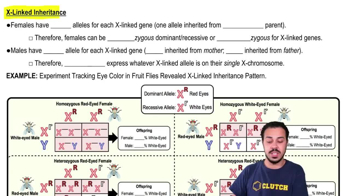
Recognize that recessive X-linked traits are more likely to be expressed in males because males have only one X chromosome, so a single recessive allele on that X chromosome will result in the trait being expressed.
Note that fathers pass their Y chromosome to their sons, not their X chromosome, so X-linked traits cannot be passed from fathers to sons.
Understand that females can be carriers of recessive X-linked traits if they have one affected X chromosome, but they usually do not express the trait unless both X chromosomes carry the recessive allele.

Verified video answer for a similar problem:

This video solution was recommended by our tutors as helpful for the problem above.
Was this helpful?

Key Concepts

Here are the essential concepts you must grasp in order to answer the question correctly.

X-linked Inheritance

X-linked inheritance refers to genes located on the X chromosome. Since males have one X and one Y chromosome, a single recessive allele on the X chromosome will be expressed in males, while females have two X chromosomes, so a recessive allele must be present on both to be expressed.
Recommended video:
07:23
X-Linked Inheritance

Expression of Recessive X-linked Traits in Males and Females

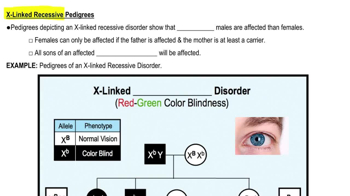
Recessive X-linked traits are more commonly expressed in males because they have only one X chromosome. Females, having two X chromosomes, are typically carriers if only one X carries the recessive allele, and the trait is usually not expressed unless both X chromosomes carry the allele.
Recommended video:
03:42
X-Linked Recessive Pedigrees

Patterns of Transmission of X-linked Traits

Fathers cannot pass X-linked traits to their sons because sons inherit the Y chromosome from their fathers. Mothers can pass X-linked traits to both sons and daughters, making maternal inheritance key in X-linked recessive conditions.
Recommended video:
07:23
X-Linked Inheritance