Ch. 3 The Cellular Level of Organization
Martini - Fundamentals of Anatomy & Physiology 11th Edition
Martini, Nath, Bartholomew11th EditionFundamentals of Anatomy & PhysiologyISBN: 9780136874089Not the one you use?Change textbook
Chapter 3, Problem 1

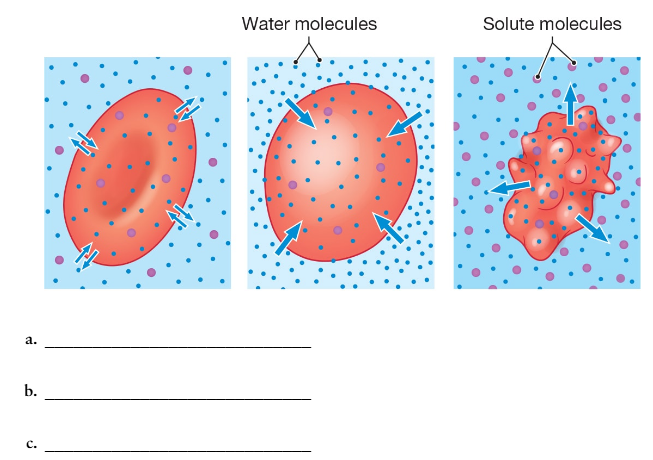
In the following diagram, identify the type of solution (hypertonic, hypotonic, or isotonic) in which the red blood cells are immersed.
Red blood cells in three solutions showing water and solute movement: swelling, stable, and shrinking shapes.

Verified step by step guidance
1
Step 1: Understand the concept of tonicity. Tonicity refers to the relative concentration of solutes outside the cell compared to inside the cell, which affects the movement of water across the cell membrane by osmosis.
Step 2: Analyze the first image (left). Water molecules (blue dots) are moving out of the red blood cell, causing it to shrink. This indicates that the solution outside has a higher solute concentration than inside the cell, so water moves out to balance the concentration. This is a hypertonic solution.
Step 3: Analyze the second image (middle). Water molecules are moving into the red blood cell, causing it to swell. This means the solution outside has a lower solute concentration than inside the cell, so water moves in. This is a hypotonic solution.
Step 4: Analyze the third image (right). There is no net movement of water into or out of the red blood cell, and the cell maintains its normal shape. This means the solute concentration inside and outside the cell is equal. This is an isotonic solution.
Step 5: Summarize the identification: The shrunken cell corresponds to a hypertonic solution, the swollen cell corresponds to a hypotonic solution, and the normal cell corresponds to an isotonic solution.

Verified video answer for a similar problem:

This video solution was recommended by our tutors as helpful for the problem above.
Video duration:
6m
Was this helpful?

Key Concepts

Here are the essential concepts you must grasp in order to answer the question correctly.

Osmosis and Water Movement

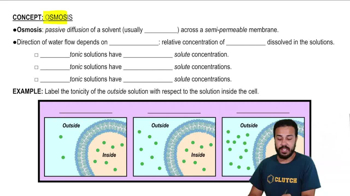
Osmosis is the passive movement of water across a semipermeable membrane from an area of lower solute concentration to higher solute concentration. In red blood cells, water moves in or out depending on the surrounding solution's tonicity, affecting cell volume and shape.
Recommended video:
05:59
Osmosis

Tonicity of Solutions

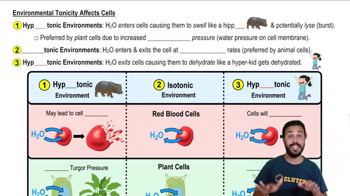
Tonicity describes the relative concentration of solutes outside the cell compared to inside. A hypertonic solution has higher solute concentration outside, causing water to leave the cell; a hypotonic solution has lower solute concentration outside, causing water to enter the cell; an isotonic solution has equal solute concentration, resulting in no net water movement.
Recommended video:
10:15
Environmental Tonicity Affects Cells

Effects of Tonicity on Red Blood Cells

In a hypertonic solution, red blood cells shrink (crenate) due to water loss. In a hypotonic solution, they swell and may burst (lyse) due to water gain. In an isotonic solution, cells maintain their normal shape and volume as water movement is balanced.
Recommended video:
10:15
Environmental Tonicity Affects Cells