List the stages of mitosis, and briefly describe the events that occur in each.
Ch. 3 The Cellular Level of Organization
Martini, Nath, Bartholomew11th EditionFundamentals of Anatomy & PhysiologyISBN: 9780136874089Not the one you use?Change textbook
All textbooks
Martini, Nath, Bartholomew 11th Edition
Ch. 3 The Cellular Level of Organization
Problem 27
Martini, Nath, Bartholomew 11th Edition
Ch. 3 The Cellular Level of Organization
Problem 27Chapter 3, Problem 27
The transport of a certain molecule exhibits the following characteristics:
(1) The molecule moves down its concentration gradient;
(2) at concentrations above a given level, the rate of transport does not increase; and
(3) cellular energy is not required for transport to occur.
Which transport process is at work?
Verified step by step guidance1
Step 1: Identify the key characteristics of the transport process described: (1) movement down the concentration gradient, (2) saturation at high concentrations, and (3) no cellular energy required.
Step 2: Understand that movement down the concentration gradient means the molecule moves from an area of higher concentration to an area of lower concentration, which is typical of passive transport.
Step 3: Recognize that saturation of the transport rate at high concentrations suggests the involvement of specific carrier proteins or channels that can become fully occupied, indicating facilitated transport rather than simple diffusion.
Step 4: Note that no cellular energy (ATP) is required, which rules out active transport mechanisms that move molecules against their concentration gradient.
Step 5: Conclude that the transport process described is facilitated diffusion, a passive transport mechanism where molecules move down their concentration gradient through specific carrier proteins or channels until saturation is reached.

Verified video answer for a similar problem:
This video solution was recommended by our tutors as helpful for the problem above.
Video duration:
2mWas this helpful?
Key Concepts
Here are the essential concepts you must grasp in order to answer the question correctly.
Passive Transport
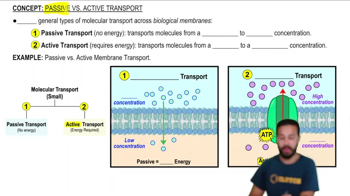
Passive transport is the movement of molecules across a cell membrane without the use of cellular energy. It occurs down the concentration gradient, from areas of higher to lower concentration, allowing substances to move freely or via specific proteins.
Recommended video:
Passive vs. Active Transport
Facilitated Diffusion
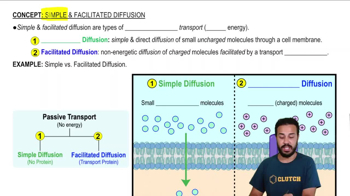
Facilitated diffusion is a type of passive transport where molecules move down their concentration gradient through specific carrier or channel proteins. It exhibits saturation kinetics, meaning the transport rate plateaus when all transport proteins are occupied.
Recommended video:
Simple and Facilitated Diffusion
Saturation Kinetics in Transport Proteins
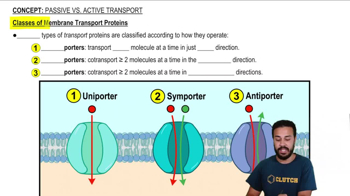
Saturation kinetics refers to the phenomenon where increasing substrate concentration no longer increases the transport rate because all carrier proteins are fully engaged. This characteristic distinguishes facilitated diffusion from simple diffusion.
Recommended video:
Classes of Membrane Transport Proteins
Related Practice
Textbook Question
156
views
Textbook Question
(a) What is cytokinesis?
72
views
Textbook Question
A molecule that blocks the ion channels lining integral proteins in the plasma membrane would interfere with
(a) Cell recognition
(b) The movement of lipid-soluble molecules
(c) Producing changes in the electrical charges across a plasma membrane
(d) The ability of protein hormones to stimulate the cell
(e) The cell's ability to divide
50
views
Textbook Question
(b) What is the role of cytokinesis in the cell cycle?
77
views
Textbook Question
What is the benefit of having some of the cellular organelles enclosed by a membrane similar to the plasma membrane?
98
views
Textbook Question
Solutions A and B are separated by a selectively permeable barrier. Over time, the level of fluid on side A increases. Which solution initially had the higher concentration of solute?
101
views