Join thousands of students who trust us to help them ace their exams!
Multiple Choice
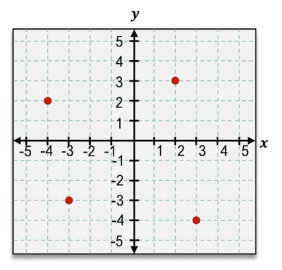
Find the domain and range for each relation. (B)
A
Domain: , Range:
B
Domain: , Range:
C
Domain: , Range:
D
Domain: , Range:
0 Comments
Verified step by step guidance
1
Step 1: Identify the coordinates of each point on the graph. Each point is represented as an ordered pair \((x, y)\) where \(x\) is the horizontal value and \(y\) is the vertical value.
Step 2: List the \(x\)-coordinates of all points to find the domain. The domain is the set of all possible \(x\)-values in the relation.
Step 3: List the \(y\)-coordinates of all points to find the range. The range is the set of all possible \(y\)-values in the relation.
Step 4: Write the domain as a set of distinct \(x\)-values, for example, \(\left\lbrace x_1, x_2, x_3, \ldots \right\rbrace\).
Step 5: Write the range as a set of distinct \(y\)-values, for example, \(\left\lbrace y_1, y_2, y_3, \ldots \right\rbrace\).


 Verified step by step guidance