Pearson+ LogoPearson+ Logo
Ch. 5 The Working Cell
Taylor - Campbell Biology: Concepts & Connections 10th Edition
Taylor, Simon, Dickey, Hogan10th EditionCampbell Biology: Concepts & ConnectionsISBN: 9780136538783Not the one you use?Change textbook
Chapter 5, Problem 8

What are the main types of cellular work? How does ATP provide the energy for this work?

Verified step by step guidance
1
Identify the three main types of cellular work: chemical work, transport work, and mechanical work. Chemical work involves endergonic reactions such as the synthesis of polymers from monomers. Transport work includes the pumping of substances across membranes against the direction of spontaneous movement. Mechanical work involves physical movements like the contraction of muscle cells or the movement of chromosomes during cellular reproduction.
Understand the structure of ATP (adenosine triphosphate), which consists of adenine, a ribose sugar, and three phosphate groups. The bonds between these phosphate groups are high-energy bonds.
Learn how ATP provides energy for cellular work. When ATP is hydrolyzed, it loses one phosphate group and releases energy, forming ADP (adenosine diphosphate) and a free phosphate group. This reaction is exergonic and releases energy that can be used by the cell.
Explore how the energy released from ATP hydrolysis is coupled to cellular work. This process is known as energy coupling. The cell uses the energy released during ATP hydrolysis to drive endergonic reactions or processes that require energy, effectively linking the exergonic process (ATP hydrolysis) with the endergonic process (cellular work).
Examine specific examples of how ATP is used for each type of cellular work. For chemical work, ATP provides the energy to form bonds in molecule synthesis. In transport work, ATP is used to change the shape of transport proteins in the cell membrane, allowing substances to move against their concentration gradients. For mechanical work, ATP is used for movements like muscle contractions or the movement of vesicles within cells.

Verified video answer for a similar problem:

This video solution was recommended by our tutors as helpful for the problem above.
Video duration:
4m
Was this helpful?

Key Concepts

Here are the essential concepts you must grasp in order to answer the question correctly.

Types of Cellular Work

Cellular work can be categorized into three main types: mechanical work, transport work, and chemical work. Mechanical work involves movement, such as muscle contraction and cell division. Transport work refers to the movement of substances across cell membranes, while chemical work encompasses the synthesis of complex molecules from simpler ones, essential for growth and maintenance.
Recommended video:
Guided course
01:06
Types of Phosphorylation

ATP (Adenosine Triphosphate)

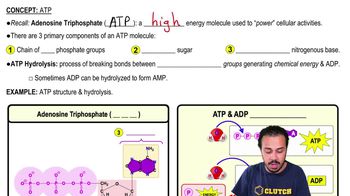
ATP, or adenosine triphosphate, is the primary energy carrier in cells. It consists of an adenosine molecule bonded to three phosphate groups. The energy stored in the high-energy bonds between these phosphate groups is released when ATP is hydrolyzed to ADP (adenosine diphosphate), providing the necessary energy for various cellular processes.
Recommended video:

Energy Coupling

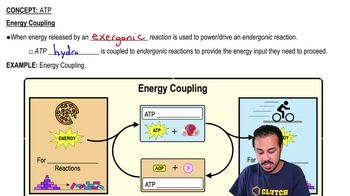
Energy coupling is the process by which energy released from exergonic reactions (like ATP hydrolysis) is used to drive endergonic reactions (which require energy). This mechanism allows cells to efficiently manage energy resources, ensuring that the energy produced from ATP can be harnessed to perform cellular work, such as muscle contraction or active transport.
Recommended video:
Guided course
04:57
Energy Coupling