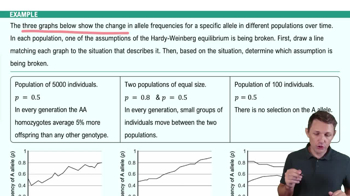
What are the five key assumptions required for a population to be in Hardy-Weinberg equilibrium?
The five key assumptions for Hardy-Weinberg equilibrium are: random mating, no mutation, no natural selection, a large (ideally infinite) population size, and no gene flow.
Under which conditions will Hardy-Weinberg equilibrium NOT occur in a population?
Hardy-Weinberg equilibrium will not occur if any of the following conditions are present: non-random mating, mutation, natural selection, small population size (genetic drift), or gene flow.
How does nonrandom mating affect genotype frequencies in a population under Hardy-Weinberg equilibrium?
Nonrandom mating changes genotype frequencies by making certain genotypes more or less common than expected. However, it does not alter allele frequencies on its own.
Why is mutation considered a rare mechanism for changing allele frequencies in large populations?
Mutation introduces new alleles but typically has a minimal effect on allele and genotype frequencies in large populations. Significant changes usually require other evolutionary mechanisms to act on the new alleles.
What role does natural selection play in disrupting Hardy-Weinberg equilibrium?
Natural selection removes specific alleles from the population, changing genotype and allele frequencies. This process pushes the population out of Hardy-Weinberg equilibrium.
Why is a very large or infinite population size necessary for Hardy-Weinberg equilibrium?
A large population size ensures that allele frequencies change only as predicted by probability, minimizing random fluctuations. Small populations are more affected by genetic drift, which can alter allele frequencies by chance.
What is genetic drift and how does it relate to Hardy-Weinberg assumptions?
Genetic drift is the random change in allele frequencies that occurs in small populations. It violates the assumption of a large population size required for Hardy-Weinberg equilibrium.
How does gene flow impact allele frequencies in a population?
Gene flow introduces or removes alleles by movement of individuals between populations. This alters allele and genotype frequencies, disrupting Hardy-Weinberg equilibrium.
Which Hardy-Weinberg assumption is not considered a mechanism of evolution and why?
Random mating is not considered a mechanism of evolution because it does not change allele frequencies, only genotype frequencies. Evolution is measured by changes in allele frequencies.
What mnemonic can help remember the five Hardy-Weinberg assumptions?
The mnemonic 'mating mutants, it's natural in flowers' represents random mating, no mutation, no natural selection, infinite population size, and no gene flow. Each word or phrase corresponds to one of the five assumptions.
 Back
Back
 06:16
06:16