Skip to main content
General Biology
My Course
Learn
Exam Prep
AI Tutor
Study Guides
Textbook Solutions
Flashcards
Explore
Try the app
My Course
Learn
Exam Prep
AI Tutor
Study Guides
Textbook Solutions
Flashcards
Explore
Try the app
Back
Building Phylogenetic Trees definitions
You can tap to flip the card.
Phylogenetic Tree
You can tap to flip the card.
👆
Phylogenetic Tree
Diagram showing evolutionary relationships among organisms, with branches representing lineage splits based on shared traits.
Track progress
Control buttons has been changed to "navigation" mode.
1/15
Related flashcards
Related practice
Recommended videos
Building Phylogenetic Trees quiz #2
Building Phylogenetic Trees
13 Terms
Building Phylogenetic Trees quiz #3
Building Phylogenetic Trees
10 Terms
25. Phylogeny
1 topic
3 problems
Chapter
Jason
05:42
Shared Derived Characters
2929
views
25
rank
06:46
Parsimony
2243
views
15
rank
04:35
Building Phylogenetic Trees Example 1
2154
views
13
rank
Terms in this set (15)
Hide definitions
Phylogenetic Tree
Diagram showing evolutionary relationships among organisms, with branches representing lineage splits based on shared traits.
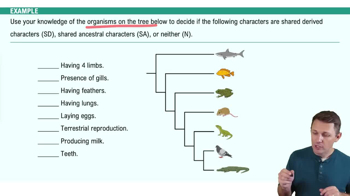
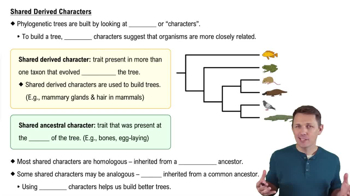
Shared Derived Character
Trait present in multiple taxa but absent in the outgroup, indicating recent common ancestry within the group.
Shared Ancestral Character
Trait inherited from a distant ancestor, present in both ingroup and outgroup, offering little insight into recent relationships.
Character Matrix
Table listing taxa and their traits, used to identify patterns of shared derived characters for tree construction.
Ingroup
Set of taxa under study whose evolutionary relationships are being determined within a phylogenetic analysis.
Outgroup
Taxon outside the ingroup, used as a reference point to distinguish ancestral from derived traits.
Homologous Trait
Feature inherited from a common ancestor, supporting evolutionary connections among taxa.
Analogous Trait
Feature with similar function or appearance in different taxa, not inherited from a common ancestor.
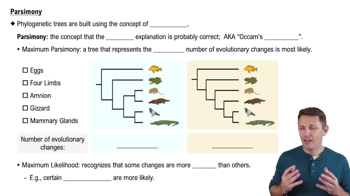
Parsimony
Principle favoring the simplest evolutionary explanation with the fewest character state changes.
Sister Taxa
Two groups sharing the most recent common ancestor, identified by the highest number of shared derived traits.
Root
Base of a phylogenetic tree, representing the most recent common ancestor of all included taxa.
Character State
Specific form or condition of a trait, such as presence or absence, used to compare taxa.
Maximum Likelihood
Statistical method evaluating which evolutionary tree is most probable, considering the likelihood of different changes.
Node
Branching point on a phylogenetic tree, representing a common ancestor from which descendant taxa diverge.
Taxon
Any named group of organisms, such as species or families, used in phylogenetic analysis.
 BackBack
 05:42
05:42