Skip to main content
General Biology
My Course
Learn
Exam Prep
AI Tutor
Study Guides
Textbook Solutions
Flashcards
Explore
Try the app
My Course
Learn
Exam Prep
AI Tutor
Study Guides
Textbook Solutions
Flashcards
Explore
Try the app
Back
Carbohydrates quiz #2
You can tap to flip the card.
Which carbohydrate can be used by the body as an immediate source of energy?
You can tap to flip the card.
👆
Which carbohydrate can be used by the body as an immediate source of energy?
Glucose is the carbohydrate that can be used by the body as an immediate source of energy.
Track progress
Control buttons has been changed to "navigation" mode.
1/40
Related flashcards
Related practice
Recommended videos
Carbohydrates definitions
Carbohydrates
9 Terms
Carbohydrates quiz #1
Carbohydrates
22 Terms
Carbohydrates exam
Carbohydrates
29 Terms
Carbohydrates
4. Biomolecules
7 problems
Topic
Jason
Proteins
4. Biomolecules
7 problems
Topic
Jason
4. Biomolecules - Part 1 of 2
5 topics
10 problems
Chapter
Jason
4. Biomolecules - Part 2 of 2
4 topics
10 problems
Chapter
Jason
Guided course
03:08
Formation & Breakdown of Polysaccharides
20689
views
317
rank
Guided course
04:53
Carbohydrates
27372
views
411
rank
1
comments
Guided course
05:08
Carbohydrate Functions
19942
views
277
rank
Terms in this set (40)
Hide definitions
Which carbohydrate can be used by the body as an immediate source of energy?
Glucose is the carbohydrate that can be used by the body as an immediate source of energy.
What is the primary function of carbohydrates attached to the exterior of cell membranes?
Carbohydrates attached to the exterior of cell membranes primarily function as chemical markers for cell recognition and communication.
Which part of the stem transports sugars?
B) Phloem
Which polysaccharide functions in structure and support in a plant's cell wall?
C) Cellulose
Which polysaccharide is an important component in the structure of many animal and fungal cells?
Chitin is an important polysaccharide in the structure of many animal and fungal cells.
What are the primary functions of carbohydrates in cells?
The primary functions of carbohydrates in cells include providing energy storage and structural support.
What is the function of carbohydrates in the cell membrane?
Carbohydrates in the cell membrane function as recognition sites for cell-to-cell communication.
What is the primary function of carbohydrates in the body?
The primary function of carbohydrates in the body is to provide energy.
Which cells transport sugars over long distances in plants?
B) Phloem cells
What function do carbohydrates fulfill in the plasma membrane?
Carbohydrates in the plasma membrane serve as recognition sites for cell signaling and communication.
Which type of carbohydrates are chemical markers on cell membranes?
Oligosaccharides serve as chemical markers on cell membranes.
What is the role of fiber in human digestion?
C) It aids in digestion
Which food is a great source of carbohydrates?
C) Bread
Which polysaccharide is stored as an energy source in the body of animals?
Glycogen is the polysaccharide stored as an energy source in the body of animals.
What monomers make up carbohydrates?
Monosaccharides
What are common sources of complex carbohydrates?
All of the above
Which biomolecule is the primary source of energy in the human diet?
Carbohydrates are the primary source of energy in the human diet.
Which vegetable is a source of complex carbohydrates?
Potatoes
What function is served by the carbohydrates attached to cell-surface proteins?
Carbohydrates attached to cell-surface proteins serve as recognition sites for cell signaling and communication.
Which is the main use of carbohydrates in cells?
The main use of carbohydrates in cells is to provide energy and structural support.
What are complex carbohydrates comprised of?
Many sugar units
What food is a best source of complex carbohydrates?
Whole grain bread
Which nutrient class supplies glucose as the main source of energy for the body?
Carbohydrates supply glucose as the main source of energy for the body.
What are carbohydrates and what is their defining structural feature?
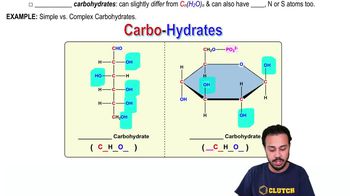
Carbohydrates are carbon-based molecules characterized by the presence of multiple hydroxyl (–OH) groups.
What is the general chemical formula for simple carbohydrates like glucose?
The general formula for simple carbohydrates is CnH2On, where n is the number of carbon atoms.
What is the chemical formula of glucose?
The chemical formula of glucose is C6H12O6.
What is an oligosaccharide and how many monosaccharide units does it contain?
An oligosaccharide contains between 2 and 20 covalently linked monosaccharide units.
What is a trisaccharide?
A trisaccharide is an oligosaccharide composed of three monosaccharide units.
What type of reaction forms polysaccharides from monosaccharides?
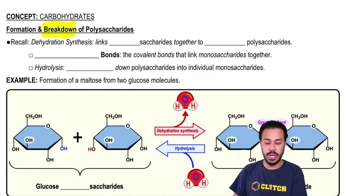
Polysaccharides are formed by dehydration synthesis reactions.
What reaction breaks down polysaccharides into monosaccharides?
Hydrolysis reactions break down polysaccharides into monosaccharides.
Which polysaccharide provides structural support in plant cell walls?
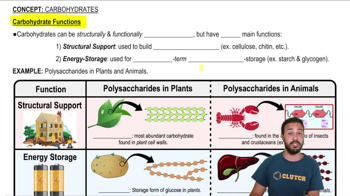
Cellulose provides structural support in plant cell walls.
Which polysaccharide is used for energy storage in plants?
Starch is used for energy storage in plants.
What is the monomer unit of carbohydrates?
The monomer unit of carbohydrates is the monosaccharide.
What is dehydration synthesis and how does it relate to carbohydrates?
Dehydration synthesis is a reaction that joins monosaccharides by removing a water molecule, forming glycosidic bonds.
What is the most abundant monosaccharide?
Glucose is the most abundant monosaccharide.
What is the main storage form of glucose in plants?
Starch is the main storage form of glucose in plants.
What is chitin and where is it found?
Chitin is a structural polysaccharide found in the exoskeletons of insects and crustaceans.
What is the function of peptidoglycan?
Peptidoglycan is a structural polysaccharide that forms the cell walls of bacteria.
What is the process called when two monosaccharides are joined together?
The process is called dehydration synthesis.
What is required to break a glycosidic bond?
A water molecule is required to break a glycosidic bond during hydrolysis.
 BackBack
 03:08
03:08