Skip to main content
General Biology
My Course
Learn
Exam Prep
AI Tutor
Study Guides
Textbook Solutions
Flashcards
Explore
Try the app
My Course
Learn
Exam Prep
AI Tutor
Study Guides
Textbook Solutions
Flashcards
Explore
Try the app
Back
Community Interactions: Exploitation (+/-) definitions
You can tap to flip the card.
Exploitation
You can tap to flip the card.
👆
Exploitation
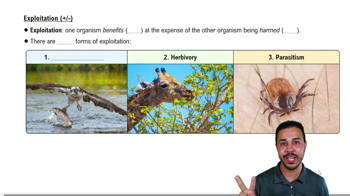
A community interaction where one organism benefits while another is harmed, encompassing predation, herbivory, and parasitism.
Track progress
Control buttons has been changed to "navigation" mode.
1/15
Related flashcards
Related practice
Recommended videos
Community Interactions: Exploitation (+/-) exam
Community Interactions: Exploitation (+/-)
29 Terms
Community Interactions: Exploitation (+/-) quiz #2
Community Interactions: Exploitation (+/-)
13 Terms
Community Interactions: Exploitation (+/-) quiz #3
Community Interactions: Exploitation (+/-)
10 Terms
51. Community Ecology
2 topics
6 problems
Chapter
Jason
Guided course
01:42
1) Exploitation (+/-): Predation
1120
views
7
rank
Guided course
02:37
3) Exploitation (+/-): Parasitism
1062
views
5
rank
Guided course
00:49
Community Interactions: Exploitation (+/–)
1078
views
6
rank
Terms in this set (15)
Hide definitions
Exploitation
A community interaction where one organism benefits while another is harmed, encompassing predation, herbivory, and parasitism.
Predation
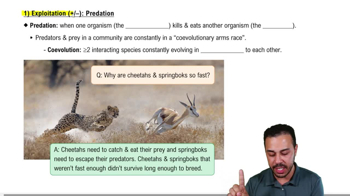
An interaction where a predator kills and consumes prey, driving reciprocal adaptations in both predator and prey.
Herbivory
A relationship where an organism consumes plants, algae, or photosynthetic bacteria, often leading to plant defenses.
Parasitism
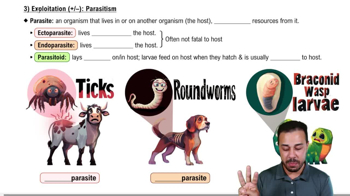
A relationship where one organism lives on or in another, extracting resources and often harming but not immediately killing the host.
Coevolution
A process where interacting species reciprocally influence each other's adaptations over time.
Ectoparasite
A parasite that resides on the external surface of its host, such as ticks on mammals.
Endoparasite
A parasite that inhabits the internal tissues or organs of its host, like roundworms in digestive tracts.
Parasitoid
An organism whose larvae develop inside or on a host, ultimately killing the host as part of their life cycle.
Aposematic Coloration
A warning display using bright colors to signal unpalatability or danger to potential predators.
Mimicry
An adaptation where one species resembles another organism or object to gain a survival advantage.
Batesian Mimicry
A harmless species imitates a harmful one to deter predators, benefiting only the mimic.
Mullerian Mimicry
Two or more harmful species share similar warning signals, reinforcing predator avoidance for all involved.
Mechanical Defense
A physical adaptation, such as thorns or shells, that protects an organism from being eaten.
Chemical Defense
A strategy where organisms produce toxins or deterrent substances to reduce the risk of being consumed.
Cryptic Coloration
A camouflage adaptation allowing organisms to blend into their environment and avoid detection by predators.
 BackBack
 01:42
01:42