Skip to main content
General Biology
My Course
Learn
Exam Prep
AI Tutor
Study Guides
Textbook Solutions
Flashcards
Explore
Try the app
My Course
Learn
Exam Prep
AI Tutor
Study Guides
Textbook Solutions
Flashcards
Explore
Try the app
Back
DNA Fingerprinting exam
You can tap to flip the card.
DNA Fingerprinting
You can tap to flip the card.
👆
DNA Fingerprinting
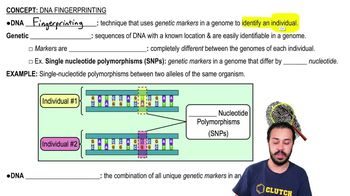
A technique using genetic markers to identify individuals.
Track progress
Control buttons has been changed to "navigation" mode.
1/29
Related flashcards
Related practice
Recommended videos
DNA Fingerprinting definitions
DNA Fingerprinting
10 Terms
DNA Fingerprinting quiz #1
DNA Fingerprinting
14 Terms
DNA Fingerprinting quiz #2
DNA Fingerprinting
11 Terms
DNA Fingerprinting
18. Biotechnology
7 problems
Topic
Jason
Introduction to DNA Sequencing
18. Biotechnology
2 problems
Topic
Jason
18. Biotechnology - Part 1 of 2
5 topics
10 problems
Chapter
Jason
18. Biotechnology - Part 2 of 2
5 topics
9 problems
Chapter
Jason
Guided course
03:41
Short Tandem Repeats (STRs)
5934
views
33
rank
Guided course
03:30
DNA Fingerprinting
4920
views
36
rank
1
comments
Terms in this set (29)
Hide definitions
DNA Fingerprinting
A technique using genetic markers to identify individuals.
What are genetic markers?
Sequences of DNA with known locations that are easily identifiable in a genome.
Polymorphisms
Differences in DNA sequences among individuals.
What is a single nucleotide polymorphism (SNP)?
A genetic marker differing by one nucleotide between individuals.
Short Tandem Repeats (STRs)
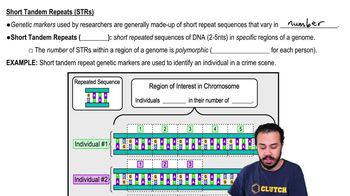
Short repeated DNA sequences, 2 to 5 nucleotides long, used as genetic markers.
How are SNPs used in DNA fingerprinting?
They serve as unique identifiers by differing in one nucleotide across individuals.
What is the significance of STRs in forensic science?
They help match DNA samples from crime scenes to suspects.
Polymorphic
Having multiple forms; in genetics, it refers to variations in DNA sequences.
How do STRs vary among individuals?
The number of repeats in specific regions of the genome differs among individuals.
What does a DNA fingerprint represent?
The combination of all unique genetic markers in an individual's genome.
Forensic Science
The application of scientific methods to solve crimes, often using DNA evidence.
What is the role of genetic markers in DNA fingerprinting?
They help identify individuals by highlighting unique DNA sequences.
How can DNA fingerprinting solve crimes?
By matching DNA from crime scenes to suspects using genetic markers like SNPs and STRs.
What is the abbreviation for single nucleotide polymorphisms?
SNPs
What is the abbreviation for short tandem repeats?
STRs
How many nucleotides long are STRs typically?
2 to 5 nucleotides long.
What makes polymorphisms useful in DNA fingerprinting?
They are unique to each individual, allowing for precise identification.
What is the main use of DNA fingerprinting in criminal investigations?
To match DNA samples from crime scenes to potential suspects.
How do SNPs differ between individuals?
By a single nucleotide change in the DNA sequence.
What is the purpose of using STRs in genetic identification?
To identify individuals based on the unique number of repeats in their DNA.
What does the term 'polymorphic' indicate in genetics?
It indicates the presence of multiple forms or variations in DNA sequences.
How are STRs identified in a genome?
By locating specific regions with short repeated sequences.
What is the key difference between SNPs and STRs?
SNPs differ by one nucleotide, while STRs vary in the number of repeated sequences.
Why are STRs important in forensic science?
They provide a unique genetic profile for individuals, aiding in identification.
What is the main advantage of using DNA fingerprinting?
It provides a highly accurate method for identifying individuals based on their genetic makeup.
How can polymorphisms be detected?
Through techniques like DNA sequencing and analysis of genetic markers.
What is the relationship between STRs and crime scene investigation?
STRs can be used to match DNA found at crime scenes with DNA from suspects.
What does a high number of STRs in a specific region indicate?
It indicates a unique genetic marker that can be used for individual identification.
How do genetic markers assist in DNA fingerprinting?
They provide specific sequences that can be compared across individuals to establish identity.
 BackBack
 03:41
03:41