Skip to main content
General Biology
My Course
Learn
Exam Prep
AI Tutor
Study Guides
Textbook Solutions
Flashcards
Explore
Try the app
My Course
Learn
Exam Prep
AI Tutor
Study Guides
Textbook Solutions
Flashcards
Explore
Try the app
Back
Energy & Biomass Pyramids definitions
You can tap to flip the card.
Energy Pyramid
You can tap to flip the card.
👆
Energy Pyramid
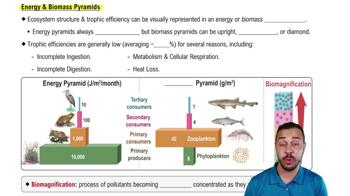
A graphical representation showing energy transfer between trophic levels over time, always upright due to decreasing energy at higher levels.
Track progress
Control buttons has been changed to "navigation" mode.
1/15
Related flashcards
Related practice
Recommended videos
Energy & Biomass Pyramids quiz #2
Energy & Biomass Pyramids
12 Terms
Energy & Biomass Pyramids quiz #3
Energy & Biomass Pyramids
11 Terms
52. Ecosystems
1 topic
3 problems
Chapter
Jason
Guided course
05:41
Energy & Biomass Pyramids
1600
views
5
rank
Guided course
03:41
Energy & Biomass Pyramids Example 1
1492
views
4
rank
Terms in this set (15)
Hide definitions
Energy Pyramid
A graphical representation showing energy transfer between trophic levels over time, always upright due to decreasing energy at higher levels.
Biomass Pyramid
A snapshot diagram displaying the mass of living organisms at each trophic level, which can be upright, inverted, or diamond-shaped.
Trophic Efficiency
The proportion of energy transferred from one trophic level to the next, typically averaging around 10% due to various losses.
Trophic Level
A position in a food chain or pyramid occupied by organisms sharing the same function in the ecosystem's energy flow.
Incomplete Ingestion
A factor limiting energy transfer, where not all available energy in one level is consumed by the next.
Incomplete Digestion
A process where not all consumed energy is assimilated, with some lost as waste, reducing energy transfer.
Metabolism
The sum of all chemical processes in organisms, requiring energy that is not passed to higher trophic levels.
Heat Loss
The dissipation of energy as thermal energy during transfer between trophic levels, contributing to low efficiency.
Biomagnification
The increasing concentration of pollutants in organisms at higher trophic levels, impacting top consumers most.
Primary Producer
An organism, such as phytoplankton, that forms the base of the food chain by generating biomass from inorganic sources.
Primary Consumer
An organism that feeds directly on primary producers, occupying the second trophic level in a food chain.
Secondary Consumer
An organism that preys on primary consumers, occupying a higher trophic level in the ecosystem.
Tertiary Consumer
A top-level organism in a food chain that feeds on secondary consumers, often most affected by biomagnification.
Phytoplankton
Microscopic aquatic producers with high reproduction rates, supporting larger masses of consumers in some biomass pyramids.
Zooplankton
Small aquatic animals that consume phytoplankton, sometimes exceeding their biomass due to rapid producer turnover.
 BackBack
 05:41
05:41