Skip to main content
General Biology
My Course
Learn
Exam Prep
AI Tutor
Study Guides
Textbook Solutions
Flashcards
Explore
Try the app
My Course
Learn
Exam Prep
AI Tutor
Study Guides
Textbook Solutions
Flashcards
Explore
Try the app
Back
Evidence of Evolution definitions
You can tap to flip the card.
Homology
You can tap to flip the card.
👆
Homology
Traits with similar underlying structures across species, indicating inheritance from a shared ancestor.
Track progress
Control buttons has been changed to "navigation" mode.
1/15
Related flashcards
Related practice
Recommended videos
Evidence of Evolution exam
Evidence of Evolution
29 Terms
Evidence of Evolution quiz #2
Evidence of Evolution
12 Terms
Evidence of Evolution quiz #3
Evidence of Evolution
19 Terms
21. Evolution by Natural Selection
1 topic
3 problems
Chapter
Jason
04:46
Types of Homologies
3382
views
31
rank
02:27
Evidence of Evolution Example 1
3081
views
27
rank
06:11
Fossils
3071
views
20
rank
Terms in this set (15)
Hide definitions
Homology
Traits with similar underlying structures across species, indicating inheritance from a shared ancestor.
Analogy
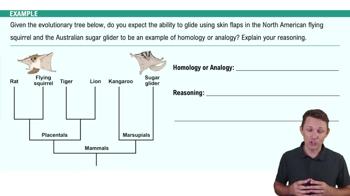
Traits with similar functions but different evolutionary origins, often misleading in determining relationships.
Vestigial Structure
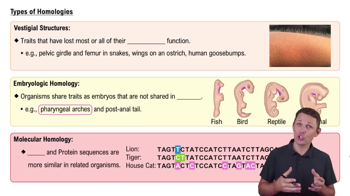
A reduced or nonfunctional trait inherited from ancestors, such as the pelvis in whales or wings in ostriches.
Embryologic Homology
Similarities in early developmental stages among different species, revealing shared ancestry.
Molecular Homology
Similarity in DNA or protein sequences among organisms, reflecting evolutionary relationships.
Fossil
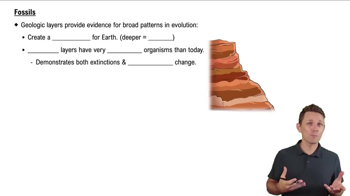
Remains or traces of ancient organisms preserved in rock layers, providing direct evidence of evolutionary change.
Tetrapod
A vertebrate with four limbs, including amphibians, reptiles, birds, and mammals.
Descent with Modification
The process by which inherited traits change over generations, leading to evolutionary diversity.
Pharyngeal Arch
Embryonic structures present in vertebrates, which develop into various adult features depending on the species.
Carpal
Wrist bones found in the forelimbs of tetrapods, part of the evidence for shared limb structure.
Extinction
The complete disappearance of a species, often documented by the absence of its fossils in recent rock layers.
Geologic Layer
Strata of sedimentary rock that serve as a timeline, with deeper layers representing older periods.
Transitional Fossil
A fossil showing intermediate traits between ancestral and derived species, illustrating evolutionary steps.
Pelvic Girdle
A set of bones in the hip region, sometimes present in reduced form as evidence of evolutionary history.
Common Ancestor
An ancestral species from which multiple descendant species have evolved, inferred through shared traits.
 BackBack
 04:46
04:46