Skip to main content
General Biology
My Course
Learn
Exam Prep
AI Tutor
Study Guides
Textbook Solutions
Flashcards
Explore
Try the app
My Course
Learn
Exam Prep
AI Tutor
Study Guides
Textbook Solutions
Flashcards
Explore
Try the app
Back
Evidence of Natural Selection definitions
You can tap to flip the card.
Natural Selection
You can tap to flip the card.
👆
Natural Selection
Process where environmental pressures favor certain traits, leading to increased reproduction of individuals with those traits.
Track progress
Control buttons has been changed to "navigation" mode.
1/15
Related flashcards
Related practice
Recommended videos
Evidence of Natural Selection exam
Evidence of Natural Selection
27 Terms
Evidence of Natural Selection quiz #1
Evidence of Natural Selection
10 Terms
21. Evolution by Natural Selection
1 topic
3 problems
Chapter
Jason
03:41
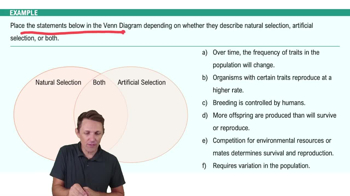
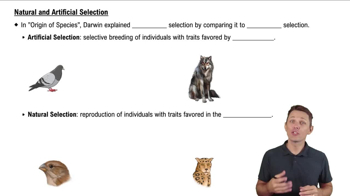
Natural and Artificial Selection
3234
views
24
rank
02:28
Evidence of Natural Selection Example 1
2890
views
21
rank
04:25
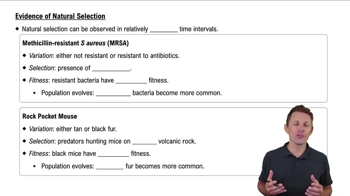
Evidence of Natural Selection
2931
views
22
rank
Terms in this set (15)
Hide definitions
Natural Selection
Process where environmental pressures favor certain traits, leading to increased reproduction of individuals with those traits.
Artificial Selection
Selective breeding by humans to enhance desired traits in organisms, such as crops, pets, or livestock.
Variation
Genetic differences among individuals in a population, providing the raw material for evolutionary change.
Fitness
Relative ability of an organism to survive and reproduce in a specific environment, influencing trait prevalence.
Selection Pressure
Environmental factor, such as predation or antibiotics, that influences which traits are advantageous.
Antibiotic Resistance
Ability of bacteria to survive and multiply despite the presence of drugs designed to kill them.
MRSA
A strain of Staphylococcus aureus that has evolved resistance to methicillin and related antibiotics.
Adaptive Evolution
Change in a population's traits over time that enhances survival and reproduction in a particular environment.
Camouflage
Trait that allows organisms to blend into their environment, reducing detection by predators.
Rock Pocket Mouse
Desert rodent known for coat color variation, providing a real-time example of adaptation to different substrates.
Gene
Unit of heredity that influences traits, such as coat color, and can be tracked as populations evolve.
Population
Group of individuals of the same species living in a specific area, subject to evolutionary processes.
Trait
Observable characteristic, such as beak size or fur color, that can be influenced by genetic and environmental factors.
Pigeon Fancier
Individual who breeds pigeons for specific characteristics, illustrating artificial selection.
Substrate
Surface or material, like volcanic rock or desert sand, that influences which traits are advantageous for survival.
 BackBack
 03:41
03:41