Skip to main content
General Biology
My Course
Learn
Exam Prep
AI Tutor
Study Guides
Textbook Solutions
Flashcards
Explore
Try the app
My Course
Learn
Exam Prep
AI Tutor
Study Guides
Textbook Solutions
Flashcards
Explore
Try the app
Back
Evolution of Populations definitions
You can tap to flip the card.
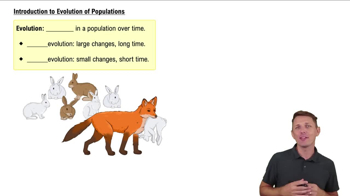
Macroevolution
You can tap to flip the card.
👆
Macroevolution
Large-scale genetic changes occurring over long periods, leading to the emergence of new species or major differences between groups.
Track progress
Control buttons has been changed to "navigation" mode.
1/15
Related flashcards
Related practice
Recommended videos
Evolution of Populations exam
Evolution of Populations
29 Terms
Evolution of Populations quiz #2
Evolution of Populations
12 Terms
Evolution of Populations quiz #3
Evolution of Populations
13 Terms
Genetic Variation
22. Evolution of Populations
7 problems
Topic
Jason
22. Evolution of Populations
2 topics
6 problems
Chapter
Jason
03:33
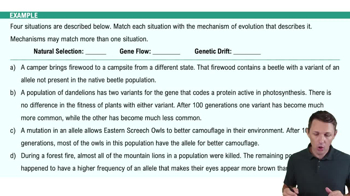
Evolution of Populations Example 1
3314
views
45
rank
05:14
Introduction to Evolution of Populations
4224
views
73
rank
Terms in this set (15)
Hide definitions
Macroevolution
Large-scale genetic changes occurring over long periods, leading to the emergence of new species or major differences between groups.
Microevolution
Small, rapid genetic changes within populations, often observable over short timeframes and driven by various mechanisms.
Allele Frequency
Proportion of a specific gene variant within a population, serving as a measure for evolutionary change.
Genetic Variation
Presence of multiple gene variants within a population, providing the raw material for evolutionary processes.
Mutation
Source of new gene variants, introducing novel alleles into a population's genetic pool.
Natural Selection
Process where certain gene variants increase in prevalence due to enhanced reproductive success.
Genetic Drift
Random fluctuations in gene variant frequencies, often impacting small populations unpredictably.
Gene Flow
Movement of gene variants between populations, altering genetic composition and diversity.
Population Genetics
Field examining how gene variants change and interact within entire populations over time.
Modern Synthesis
Integration of Darwinian evolution and Mendelian genetics, forming the foundation of contemporary evolutionary theory.
Chromosome
Structure carrying genetic information, composed of DNA and housing gene variants that underlie traits.
Gene
Segment of DNA responsible for coding traits, existing in different forms within a population.
Variant
Alternative form of a gene, contributing to observable differences among individuals in a population.
Reproductive Success
Measure of an individual's genetic contribution to future generations, influencing gene variant prevalence.
Common Ancestor
Shared predecessor from which different species or populations have diverged through evolutionary processes.
 BackBack
 03:33
03:33