Skip to main content
General Biology
My Course
Learn
Exam Prep
AI Tutor
Study Guides
Textbook Solutions
Flashcards
Explore
Try the app
My Course
Learn
Exam Prep
AI Tutor
Study Guides
Textbook Solutions
Flashcards
Explore
Try the app
Back
Factors Limiting Population Growth definitions
You can tap to flip the card.
Population Density
You can tap to flip the card.
👆
Population Density
Number of individuals per unit area, influencing how certain ecological factors affect population growth.
Track progress
Control buttons has been changed to "navigation" mode.
1/15
Related flashcards
Related practice
Recommended videos
Factors Limiting Population Growth exam
Factors Limiting Population Growth
26 Terms
Factors Limiting Population Growth quiz #2
Factors Limiting Population Growth
15 Terms
Factors Limiting Population Growth quiz #3
Factors Limiting Population Growth
19 Terms
50. Population Ecology
1 topic
3 problems
Chapter
Jason
Guided course
02:37
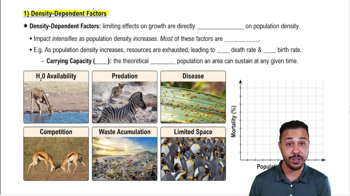
Density-Dependent Factors
1717
views
7
rank
Guided course
00:51
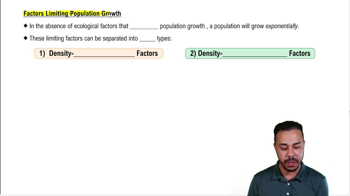
Factors Limiting Population Growth
1527
views
6
rank
Guided course
03:14
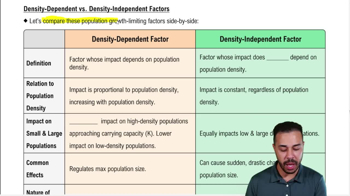
Density-Dependent vs. Density-Independent Factors
1901
views
6
rank
Terms in this set (15)
Hide definitions
Population Density
Number of individuals per unit area, influencing how certain ecological factors affect population growth.
Density Dependent Factor
Limiting influence whose effect intensifies as the number of individuals in a given area increases.
Density Independent Factor
Limiting influence that impacts populations equally, regardless of how crowded the population is.
Carrying Capacity
Maximum number of individuals an environment can sustainably support at a given time.
Competition
Struggle among organisms for limited resources, intensifying as population density rises.
Predation
Biotic interaction where one organism consumes another, with effects that grow as populations become denser.
Disease
Spread of pathogens within a population, increasing in impact as individuals become more crowded.
Waste Accumulation
Build-up of byproducts from organisms, which can harm populations more as density increases.
Natural Disaster
Abiotic event such as a hurricane or flood that can drastically reduce population size, regardless of density.
Abiotic Factor
Nonliving environmental influence, often responsible for density independent limitations on populations.
Biotic Factor
Living component of the environment, typically associated with density dependent effects on populations.
Resource Availability
Access to essentials like food and water, which becomes more limited as population density increases.
Limited Space
Restriction in available habitat, intensifying competition and other effects as populations grow.
Mortality Rate
Frequency of deaths within a population, which can rise due to both density dependent and independent factors.
Exponential Growth
Rapid population increase occurring when limiting factors are absent, rarely sustained in natural environments.
 BackBack
 02:37
02:37