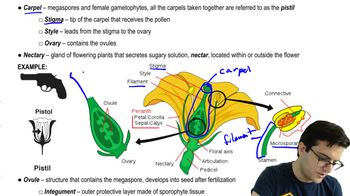
Which type of flower is missing either the pistil or the stamen?
An imperfect flower is missing either the pistil or the stamen.
What is the function of sepals during flower formation?
Protect flower buds
Which structure in the plant produces pollen for plant reproduction?
The anther produces pollen for plant reproduction.
Which structure is a stalk that supports a single flower?
The peduncle is the stalk that supports a single flower.
What is the function of fruits?
Protect seeds
Through which process is pollen transferred from male to female flower parts?
Pollination is the process through which pollen is transferred from male to female flower parts.
Which structure houses a plant's pollen prior to pollination?
The anther houses a plant's pollen prior to pollination.
What four parts are required for a flower to be considered complete?
A complete flower has sepals, petals, stamens, and pistils.
Which part of an angiosperm is sticky and collects pollen?
The stigma is sticky and collects pollen.
What is a function that flowers do not perform?
Conduct photosynthesis
What structure directly produces the fruit of angiosperms?
Ovary
How do most flowering plants avoid self-fertilization?
Most flowering plants avoid self-fertilization through mechanisms like self-incompatibility, temporal separation, and spatial avoidance.
Which flower part develops into the pulp of a fleshy fruit?
Ovary
What is a complete flower?
A complete flower contains all four main parts: sepals, petals, stamens, and pistils.
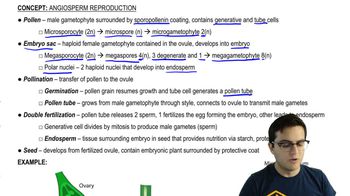
What plant structure most directly produces the pollen tube of angiosperms?
Tube cell
Which structure in a flower is not directly involved in reproduction?
Petal
Which type of flower is missing either the pistil or the stamen? Responses: A) Complete B) Incomplete C) Perfect D) Imperfect
D) Imperfect
What structures are usually the showy parts of a flower?
Petals are usually the showy parts of a flower.
What part of the flower attracts pollinators?
Petals attract pollinators.
What are the male and female parts of a flower?
The male part is the stamen, and the female part is the pistil (or carpel).
Which structure of a flower traps pollen?
The stigma traps pollen.
What advantage to the flower are colorful petals?
Colorful petals attract pollinators.
Which part of a plant creates pollen?
The anther creates pollen.
What part of the flower produces pollen?
The anther produces pollen.
What are the possible agents that can spread pollen?
All of the above (Wind, Water, Animals)
The pollen lands on which part of the flower?
The pollen lands on the stigma.
Which part of the plant flower produces and holds the pollen?
The anther produces and holds the pollen.
Which structure of a flower releases pollen? Anther, Sepal, Pistil, Ovary
Anther
Which structures carry pollen?
Pollen grains carry pollen.
What part of a flower produces pollen?
The anther produces pollen.
What is true concerning flowering plants regarding their life cycle?
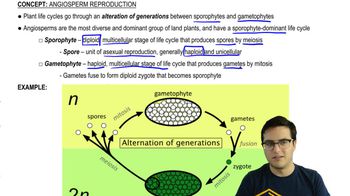
They exhibit alteration of generations
Where in the flower are pollen grains produced?
Pollen grains are produced in the anther.
Which agents conduct the most pollination for angiosperms?
Animals
Which part of a flower contains the ovary?
The pistil (or carpel) contains the ovary.
Which part of the flower produces pollen?
The anther produces pollen.
What is the dominant generation in the life cycle of angiosperms, and what is its primary function?
The dominant generation in angiosperms is the sporophyte, which is diploid and produces haploid spores through meiosis.
Describe the process and significance of double fertilization in angiosperms.
Double fertilization occurs when one sperm fertilizes the egg to form the embryo, while a second sperm fuses with two polar nuclei to form nutrient-rich endosperm, supporting embryo development.
Differentiate between complete, incomplete, perfect, and imperfect flowers.
Complete flowers have all four main parts (sepals, petals, stamens, carpels); incomplete flowers lack one or more. Perfect flowers have both stamens and carpels (bisexual), while imperfect flowers have only one (unisexual).
What mechanisms do angiosperms use to prevent self-pollination and promote genetic diversity?
Angiosperms prevent self-pollination through self-incompatibility, temporal separation (different maturation times), and spatial avoidance (physical separation of male and female organs).
 Back
Back
 04:08
04:08