Skip to main content
General Biology
My Course
Learn
Exam Prep
AI Tutor
Study Guides
Textbook Solutions
Flashcards
Explore
Try the app
My Course
Learn
Exam Prep
AI Tutor
Study Guides
Textbook Solutions
Flashcards
Explore
Try the app
Back
Freshwater Aquatic Biomes definitions
You can tap to flip the card.
Oligotrophic Lake
You can tap to flip the card.
👆
Oligotrophic Lake
A body of water with low nutrient levels, high oxygen content, clear and cold water, and limited primary productivity.
Track progress
Control buttons has been changed to "navigation" mode.
1/15
Related flashcards
Related practice
Recommended videos
Freshwater Aquatic Biomes exam
Freshwater Aquatic Biomes
27 Terms
Freshwater Aquatic Biomes quiz #2
Freshwater Aquatic Biomes
12 Terms
Freshwater Aquatic Biomes quiz #3
Freshwater Aquatic Biomes
15 Terms
48. Ecology
1 topic
3 problems
Chapter
Nicole
Guided course
01:29
Wetlands
1715
views
6
rank
Guided course
01:51
Estuaries
1551
views
5
rank
Guided course
01:41
Streams & Rivers
1646
views
8
rank
Terms in this set (15)
Hide definitions
Oligotrophic Lake
A body of water with low nutrient levels, high oxygen content, clear and cold water, and limited primary productivity.
Eutrophic Lake
A nutrient-rich, oxygen-poor water body with abundant plant and algae growth, often resulting in murky water and high productivity.
Primary Productivity
The rate at which photosynthetic organisms produce organic compounds, influencing ecosystem energy flow.
Decomposition
The breakdown of organic matter, consuming oxygen and impacting oxygen levels in aquatic environments.
Tributary
A smaller flowing water body that contributes water to a larger river or stream.
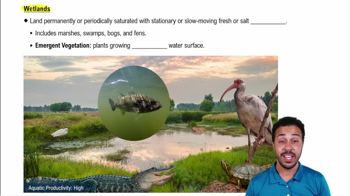
Wetland
Land saturated with water, either permanently or periodically, supporting diverse plant and animal life.
Marsh
A type of wetland dominated by herbaceous plants and characterized by standing or slow-moving water.
Swamp
A wetland with saturated soils, often featuring woody plants like trees and shrubs.
Bog
A wetland with acidic, nutrient-poor water, often supporting mosses and unique plant species.
Fen
A wetland with alkaline, mineral-rich water, supporting grasses, sedges, and other specialized plants.
Emergent Vegetation
Plants rooted underwater but extending above the surface, common in wetlands and crucial for habitat structure.
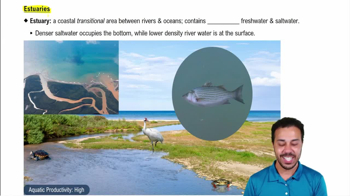
Estuary
A coastal zone where freshwater from rivers mixes with saltwater from the ocean, creating dynamic salinity conditions.
Salinity
The concentration of dissolved salts in water, varying in estuaries due to tidal influences.
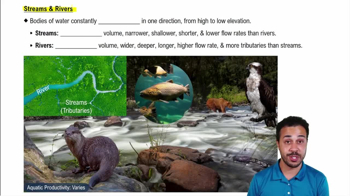
Stream
A small, flowing freshwater body, typically narrower and shallower than a river.
River
A large, flowing freshwater body with greater volume, width, and depth, often fed by multiple tributaries.
 BackBack
 01:29
01:29