Skip to main content
General Biology
My Course
Learn
Exam Prep
AI Tutor
Study Guides
Textbook Solutions
Flashcards
Explore
Try the app
My Course
Learn
Exam Prep
AI Tutor
Study Guides
Textbook Solutions
Flashcards
Explore
Try the app
Back
History of Evolutionary Thought definitions
You can tap to flip the card.
Natural Selection
You can tap to flip the card.
👆
Natural Selection
A process where environmental pressures and genetic variation lead to changes in species over generations.
Track progress
Control buttons has been changed to "navigation" mode.
1/15
Related flashcards
Related practice
Recommended videos
History of Evolutionary Thought exam
History of Evolutionary Thought
28 Terms
History of Evolutionary Thought quiz #2
History of Evolutionary Thought
12 Terms
History of Evolutionary Thought quiz #3
History of Evolutionary Thought
11 Terms
21. Evolution by Natural Selection
1 topic
3 problems
Chapter
Jason
04:22
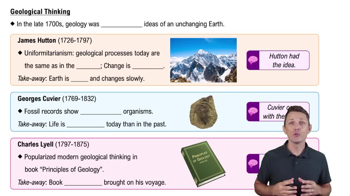
Geological Thinking
3877
views
41
rank
02:45
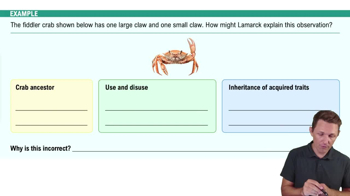
History of Evolutionary Theory Example 1
2950
views
31
rank
07:37
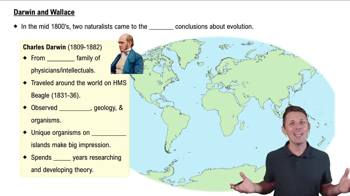
Darwin and Wallace
3319
views
27
rank
Terms in this set (15)
Hide definitions
Natural Selection
A process where environmental pressures and genetic variation lead to changes in species over generations.
Uniformitarianism
A geological concept stating that Earth's processes occurring today also operated in the past, shaping landforms gradually.
Great Chain of Being
A hierarchical structure historically used to classify all living things, with species viewed as fixed and unchanging.
Fossil Record
Physical evidence preserved in rocks showing extinct organisms and revealing that life has changed over time.
Inheritance of Acquired Traits
A disproven idea suggesting that characteristics gained during an organism's life can be passed to offspring.
Genetic Variation
Differences in DNA among individuals within a population, providing the raw material for evolutionary change.
Principles of Geology
A foundational book by Charles Lyell that influenced Darwin by emphasizing gradual geological change.
Galapagos Islands
A volcanic archipelago where unique species observed by Darwin provided key insights into adaptation and evolution.
Wallace Line
A biogeographical boundary in the Malay Archipelago marking a sharp difference in species between Asia and Australia.
Paleontology
The scientific study of fossils, revealing extinct species and supporting the concept of life's historical change.
Adaptation
A trait shaped by natural selection that increases an organism's fitness in a specific environment.
Extinction
The permanent disappearance of a species, evidenced by fossils and indicating that life forms are not fixed.
Species Distribution
The geographic arrangement of organisms, which provided clues to evolutionary processes for both Darwin and Wallace.
HMS Beagle
The ship on which Darwin traveled, enabling observations that led to the development of evolutionary theory.
Marsupials
A group of mammals, such as kangaroos, whose distribution helped Wallace identify biogeographical patterns.
 BackBack
 04:22
04:22