Skip to main content
General Biology
My Course
Learn
Exam Prep
AI Tutor
Study Guides
Textbook Solutions
Flashcards
Explore
Try the app
My Course
Learn
Exam Prep
AI Tutor
Study Guides
Textbook Solutions
Flashcards
Explore
Try the app
Back
Introduction to Energy exam
You can tap to flip the card.
Energy
You can tap to flip the card.
👆
Energy
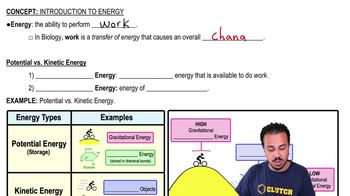
The ability to perform work or cause an overall change in a living system.
Track progress
Control buttons has been changed to "navigation" mode.
1/29
Related flashcards
Related practice
Recommended videos
Introduction to Energy definitions
Introduction to Energy
6 Terms
Introduction to Energy quiz #1
Introduction to Energy
23 Terms
Introduction to Energy quiz #2
Introduction to Energy
39 Terms
Introduction to Energy
7. Energy and Metabolism
4 problems
Topic
Jason
Laws of Thermodynamics
7. Energy and Metabolism
4 problems
Topic
Jason
7. Energy and Metabolism
10 topics
13 problems
Chapter
Brendan
Guided course
04:21
Thermodynamics: System vs. Surroundings
19931
views
312
rank
Guided course
04:58
Introduction to Energy
26994
views
528
rank
2
comments
Terms in this set (29)
Hide definitions
Energy
The ability to perform work or cause an overall change in a living system.
Potential Energy
Stored energy that is available to do work or cause change.
Kinetic Energy
The energy of motion.
Thermodynamics
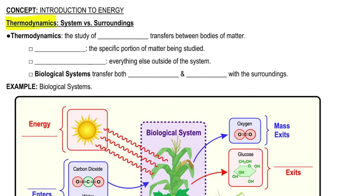
The study of energy transfers between different bodies of matter.
System (in thermodynamics)
The specific portion of matter being studied.
Surroundings (in thermodynamics)
Everything outside the system.
What is gravitational potential energy?
Energy stored due to an object's position relative to gravity, such as a biker at the top of a hill.
What is chemical potential energy?
Energy stored in chemical bonds, such as in glucose.
What is an example of kinetic energy?
A biker coasting down a hill or muscle contractions.
What happens to potential energy when a biker starts moving down a hill?
It is converted into kinetic energy.
What is the role of solar energy in photosynthesis?
Solar energy enters the biological system (plant) to help produce glucose and oxygen.
What can biological systems exchange with their surroundings?
Energy and mass.
What enters a plant during photosynthesis?
Solar energy, carbon dioxide, and water.
What exits a plant during photosynthesis?
Glucose and oxygen.
What is the most abundant sugar that exists?
Glucose.
What is work in the context of biology?
The transfer of energy that causes an overall change.
What is an example of a system in thermodynamics?
An entire living organism or a single specific reaction.
What is the main takeaway about biological systems in thermodynamics?
They can allow energy and mass to enter and exit the system in different forms.
What is the energy of motion called?
Kinetic energy.
What type of energy does a biker at the top of a hill have?
Gravitational potential energy.
What is the definition of potential energy?
Stored energy that has the potential to do work.
What is the definition of kinetic energy?
Energy associated with objects in motion.
What is the study of energy transfers called?
Thermodynamics.
What is the specific portion of matter being studied in thermodynamics?
The system.
What encompasses everything outside the system in thermodynamics?
The surroundings.
What is an example of chemical potential energy?
Energy stored in glucose.
What is the energy transformation when a biker moves down a hill?
Potential energy is converted into kinetic energy.
What is the role of glucose in photosynthesis?
It is produced as a form of chemical potential energy.
What is the main function of photosynthesis in terms of energy?
Converting solar energy into chemical potential energy in the form of glucose.
 BackBack

 04:21
04:21