Skip to main content
General Biology
My Course
Learn
Exam Prep
AI Tutor
Study Guides
Textbook Solutions
Flashcards
Explore
Try the app
My Course
Learn
Exam Prep
AI Tutor
Study Guides
Textbook Solutions
Flashcards
Explore
Try the app
Back
Introduction to Population Growth Models definitions
You can tap to flip the card.
Population Growth Model
You can tap to flip the card.
👆
Population Growth Model
A mathematical framework used to describe and predict changes in population size over time, simplifying complex biological interactions.
Track progress
Control buttons has been changed to "navigation" mode.
1/14
Related flashcards
Related practice
Recommended videos
Introduction to Population Growth Models exam
Introduction to Population Growth Models
28 Terms
Introduction to Population Growth Models quiz #1
Introduction to Population Growth Models
11 Terms
50. Population Ecology
1 topic
3 problems
Chapter
Jason
Guided course
02:52
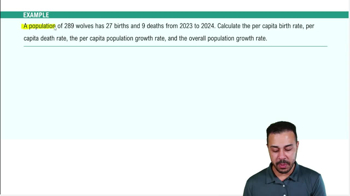
Introduction to Population Growth Models Example 3
1165
views
5
rank
Guided course
01:09
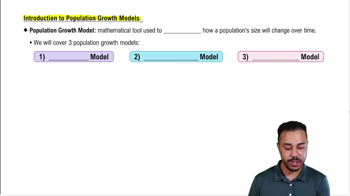
Introduction to Population Growth Models
1524
views
9
rank
Guided course
03:29
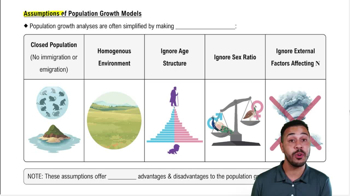
Assumptions of Population Growth Models
1335
views
6
rank
Terms in this set (14)
Hide definitions
Population Growth Model
A mathematical framework used to describe and predict changes in population size over time, simplifying complex biological interactions.
Linear Growth Model
A model where population size changes by a constant amount each time period, assuming a fixed growth rate.
Exponential Growth Model
A model where population size increases at a rate proportional to its current size, leading to rapid growth under ideal conditions.
Logistic Growth Model
A model where population growth slows as it approaches a carrying capacity, reflecting resource limitations.
Closed Population
A group where immigration and emigration are absent or balanced, so only births and deaths affect population size.
Homogeneous Environment
A setting where resources are evenly distributed and all individuals have equal access, simplifying population modeling.
Age Structure
The distribution of individuals among different age groups within a population, influencing growth but often ignored in basic models.
Sex Ratio
The proportion of males to females in a population, which can impact growth but is typically disregarded in simplified models.
Population Growth Rate
The overall change in population size over a specific time period, calculated as delta n over delta t.
Per Capita Growth Rate
The average contribution of each individual to population growth, often represented by r and calculated per individual.
Intrinsic Rate of Increase
A measure of how fast a population can grow per individual under ideal conditions, synonymous with per capita growth rate.
r max
The maximum possible per capita growth rate for a species under perfect conditions, determined by species biology.
Density Independent Factor
An external influence, such as a natural disaster, that affects population size regardless of its density.
Carrying Capacity
The maximum population size that an environment can sustain, a key concept in logistic growth models.
 BackBack
 02:52
02:52