Skip to main content
General Biology
My Course
Learn
Exam Prep
AI Tutor
Study Guides
Textbook Solutions
Flashcards
Explore
Try the app
My Course
Learn
Exam Prep
AI Tutor
Study Guides
Textbook Solutions
Flashcards
Explore
Try the app
Back
Introduction to Terrestrial Biomes definitions
You can tap to flip the card.
Biome
You can tap to flip the card.
👆
Biome
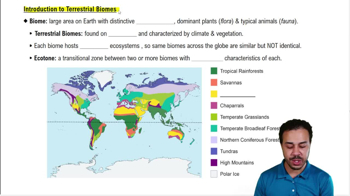
A large land area defined by distinctive climate, dominant vegetation, and characteristic animal life.
Track progress
Control buttons has been changed to "navigation" mode.
1/15
Related flashcards
Related practice
Recommended videos
Introduction to Terrestrial Biomes exam
Introduction to Terrestrial Biomes
29 Terms
Introduction to Terrestrial Biomes quiz #2
Introduction to Terrestrial Biomes
36 Terms
Introduction to Terrestrial Biomes quiz #3
Introduction to Terrestrial Biomes
38 Terms
48. Ecology
1 topic
3 problems
Chapter
Nicole
Guided course
01:29
Introduction to Terrestrial Biomes Example 2
1703
views
5
rank
Guided course
01:55
Introduction to Terrestrial Biomes
1984
views
18
rank
Guided course
00:49
Introduction to Terrestrial Biomes Example 1
1968
views
10
rank
Terms in this set (15)
Hide definitions
Biome
A large land area defined by distinctive climate, dominant vegetation, and characteristic animal life.
Terrestrial Biome
A land-based region with unique climate and vegetation, differing from aquatic environments.
Climate
The long-term pattern of temperature and precipitation that shapes the characteristics of a region.
Flora
The collective plant life typical to a specific region or biome.
Fauna
The typical animal species inhabiting a particular biome or region.
Ecosystem
A community of living organisms interacting with each other and their physical environment within a biome.
Echotone
A transitional zone where two or more biomes gradually blend, often with mixed characteristics.
Disturbance
A short-lived event that disrupts ecosystem structure and function, altering resource distribution.
Disturbance Regime
A predictable pattern of recurring disruptions that maintain ecological balance in certain biomes.
Wildfire
A natural or human-caused fire event that can regulate fuel levels and influence species composition.
Fuel Accumulation
The buildup of organic material, such as leaves and branches, that can intensify fire events.
Species Distribution
The spatial arrangement of plant and animal populations within a biome, influenced by environmental factors.
Resource Availability
The accessibility of essentials like water, nutrients, and light that support life in an ecosystem.
Biodiversity
The variety of living organisms present within a biome, contributing to ecosystem resilience.
Resilience
The capacity of an ecosystem to recover from disturbances and maintain its essential functions.
 BackBack
 01:29
01:29