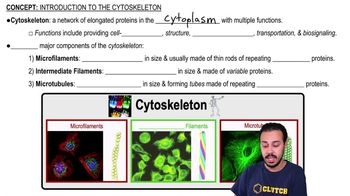
Name the three main components of the cytoskeleton and describe the primary protein that makes up each.
The three main components are microfilaments (made of actin), intermediate filaments (made of various proteins), and microtubules (made of tubulin).
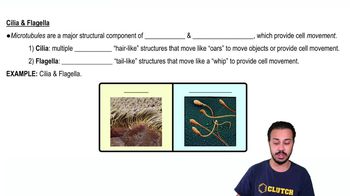
What is the structural and functional difference between cilia and flagella?
Cilia are short, numerous, hair-like structures that move like oars to move objects or the cell, while flagella are longer, whip-like structures that primarily move the cell itself.
Why is the cytoskeleton described as dynamic, and what is the significance of this property?
The cytoskeleton is dynamic because its components can be rapidly assembled and disassembled, allowing the cell to adapt its shape, structure, and movement as needed.
What role does the cytoskeleton play in cell signaling and environmental response?
The cytoskeleton helps cells communicate with each other and respond to environmental changes by reorganizing its structure and facilitating signal transduction.
What are the three main components of the cytoskeleton and what is the primary protein that makes up each?
The three main components are microfilaments (made of actin), intermediate filaments (made of various proteins), and microtubules (made of tubulin).
How do cilia and flagella differ in structure and function?
Cilia are short, numerous, hair-like structures that move like oars to move objects or the cell, while flagella are longer, whip-like structures that primarily move the cell itself.
Why is the cytoskeleton described as dynamic, and why is this property important?
The cytoskeleton is dynamic because its components can be rapidly assembled and disassembled, allowing the cell to adapt its shape, structure, and movement as needed.
What role does the cytoskeleton play in cell signaling and environmental response?
The cytoskeleton helps cells communicate with each other and respond to environmental changes by reorganizing its structure and facilitating signal transduction.
Which cytoskeletal component is the smallest, and what is it made of?
Microfilaments are the smallest cytoskeletal component and are made of repeating actin protein subunits.
What is the main structural component of both cilia and flagella, and what is its significance?
Both cilia and flagella are primarily made of microtubules, which are important for providing cell movement.
Are flagella present in both plant and animal cells?
Flagella are typically found in animal cells, such as sperm cells, but are generally not present in most plant cells.
What is the main function of centrosomes in animal cells?
The main function of centrosomes in animal cells is to organize microtubules, which are important for maintaining cell structure, facilitating cell division, and enabling cell movement.
Which structures of the cytoskeleton are found in animal cells?
Animal cells contain all three main cytoskeletal structures: microfilaments (made of actin), intermediate filaments (composed of various proteins), and microtubules (made of tubulin).
 Back
Back


 03:15
03:15