Skip to main content
General Biology
My Course
Learn
Exam Prep
AI Tutor
Study Guides
Textbook Solutions
Flashcards
Explore
Try the app
My Course
Learn
Exam Prep
AI Tutor
Study Guides
Textbook Solutions
Flashcards
Explore
Try the app
Back
Life History definitions
You can tap to flip the card.
Life History
You can tap to flip the card.
👆
Life History
An organism's overall strategy for allocating energy, resources, and time to growth, survival, and reproduction.
Track progress
Control buttons has been changed to "navigation" mode.
1/13
Related flashcards
Related practice
Recommended videos
Life History exam
Life History
28 Terms
Life History quiz #2
Life History
15 Terms
Life History quiz #3
Life History
10 Terms
50. Population Ecology
1 topic
3 problems
Chapter
Jason
Guided course
04:01
Life History
2038
views
15
rank
Guided course
02:51
Life History: Population Reproductive Strategies
1718
views
10
rank
Guided course
02:46
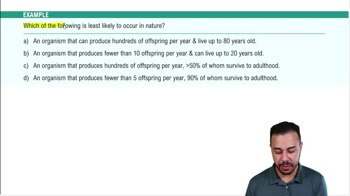
Life History Example 1
1815
views
6
rank
Terms in this set (13)
Hide definitions
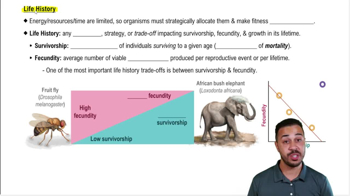
Life History
An organism's overall strategy for allocating energy, resources, and time to growth, survival, and reproduction.
Survivorship
The proportion of individuals in a population that survive to a specific age, reflecting chances of reaching adulthood.
Fecundity
The reproductive capacity, often measured as the average number of viable offspring produced per event or lifetime.
Mortality
The proportion of individuals in a population dying at a given age, essentially the inverse of survivorship.
Trade-off
A situation where increasing one trait, like survival, reduces another, such as reproductive output, due to limited resources.
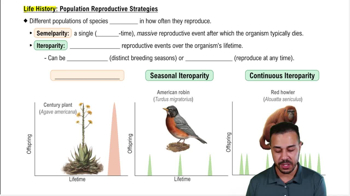
Semelparity
A reproductive strategy involving a single, massive reproductive event, often followed by death, as seen in century plants.
Iteroparity
A reproductive strategy with multiple reproductive events throughout an organism's life, which may be seasonal or continuous.
Seasonal Iteroparity
A pattern where reproductive events occur only during specific breeding seasons, resulting in evenly spaced offspring production.
Continuous Iteroparity
A pattern where reproductive events can occur at any time, without fixed intervals, once reproductive maturity is reached.
Lifespan
The expected duration of an organism's life, often associated with its survivorship and reproductive strategy.
Fitness
The overall ability to survive and reproduce, shaped by how energy and resources are allocated across life history traits.
Reproductive Event
An occurrence during which an organism produces offspring, which may happen once or multiple times depending on strategy.
Developmental Growth
The process by which an organism increases in size and complexity, influenced by energy allocation decisions.
 BackBack
 04:01
04:01