Skip to main content
General Biology
My Course
Learn
Exam Prep
AI Tutor
Study Guides
Textbook Solutions
Flashcards
Explore
Try the app
My Course
Learn
Exam Prep
AI Tutor
Study Guides
Textbook Solutions
Flashcards
Explore
Try the app
Back
Marine Aquatic Biomes definitions
You can tap to flip the card.
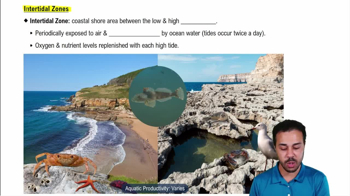
Intertidal Zone
You can tap to flip the card.
👆
Intertidal Zone
Coastal area between high and low tides, experiencing both air exposure and submersion twice daily, supporting specially adapted organisms.
Track progress
Control buttons has been changed to "navigation" mode.
1/15
Related flashcards
Related practice
Recommended videos
Marine Aquatic Biomes exam
Marine Aquatic Biomes
28 Terms
Marine Aquatic Biomes quiz #1
Marine Aquatic Biomes
15 Terms
48. Ecology
1 topic
3 problems
Chapter
Nicole
Guided course
01:43
Intertidal Zones
1636
views
8
rank
Guided course
01:30
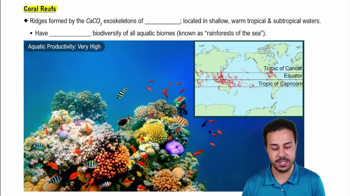
Coral Reefs
1609
views
10
rank
Guided course
01:47
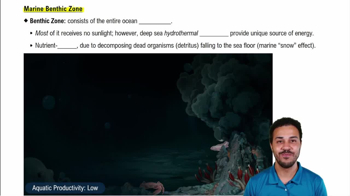
Marine Benthic Zone
1787
views
9
rank
Terms in this set (15)
Hide definitions
Intertidal Zone
Coastal area between high and low tides, experiencing both air exposure and submersion twice daily, supporting specially adapted organisms.
Marine Pelagic Zone
Vast open ocean biome, spanning from the surface to just above the ocean floor, covering about three-quarters of Earth's surface.
Coral Reef
Complex underwater structures formed by calcium carbonate exoskeletons of coral polyps, known for exceptional biodiversity.
Marine Benthic Zone
Ocean floor region, ranging from shallow to deep areas, often nutrient-rich due to accumulation of decomposing biomass.
Tidal Pool
Small water pocket in the intertidal zone, retaining marine life during low tide and replenished with nutrients and oxygen at high tide.
Sunlight Gradient
Variation in light intensity with ocean depth, with high levels at the surface and complete darkness in deeper waters.
Nutrient Gradient
Increase in nutrient concentration with ocean depth, primarily due to sinking and decomposition of surface biomass.
Biomass Gradient
Decrease in living organic matter as ocean depth increases, with most biomass concentrated near the surface.
Oxygen Gradient
Decline in dissolved oxygen levels as depth increases, affecting the distribution of marine organisms.
Coral Polyp
Small aquatic animal that secretes calcium carbonate, building the foundational structure of coral reefs.
Calcium Carbonate
Mineral compound secreted by coral polyps, forming the sturdy exoskeletons that make up coral reefs.
Hydrothermal Vent
Deep-sea opening in the benthic zone emitting chemical-rich fluids, supporting unique ecosystems independent of sunlight.
Detritus
Decomposing organic matter from dead organisms, accumulating on the ocean floor and enriching benthic habitats.
Marine Snow
Continuous fall of organic particles from upper waters to the ocean floor, delivering nutrients to deep-sea environments.
Biodiversity Hotspot
Area with exceptionally high species richness, such as coral reefs, supporting complex and productive ecosystems.
 BackBack
 01:43
01:43