Skip to main content
General Biology
My Course
Learn
Exam Prep
AI Tutor
Study Guides
Textbook Solutions
Flashcards
Explore
Try the app
My Course
Learn
Exam Prep
AI Tutor
Study Guides
Textbook Solutions
Flashcards
Explore
Try the app
Back
Meiosis II quiz #4
You can tap to flip the card.
How does meiosis II differ from mitosis in terms of the starting cell type?
You can tap to flip the card.
👆
How does meiosis II differ from mitosis in terms of the starting cell type?
Meiosis II starts with haploid cells produced by meiosis I, while mitosis starts with diploid cells.
Track progress
Control buttons has been changed to "navigation" mode.
1/10
Related flashcards
Related practice
Recommended videos
Meiosis II definitions
Meiosis II
11 Terms
Meiosis II quiz #1
Meiosis II
15 Terms
Meiosis II exam
Meiosis II
23 Terms
Meiosis II
12. Meiosis
5 problems
Topic
Jason
Genetic Variation During Meiosis
12. Meiosis
7 problems
Topic
Jason
12. Meiosis
8 topics
15 problems
Chapter
Jason
Guided course
06:17
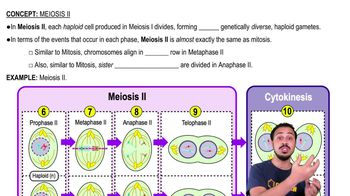
Meiosis II
11863
views
132
rank
1
comments
Terms in this set (10)
Hide definitions
How does meiosis II differ from mitosis in terms of the starting cell type?
Meiosis II starts with haploid cells produced by meiosis I, while mitosis starts with diploid cells.
How many cells are produced at the end of meiosis II, and what is their ploidy?
Meiosis II produces four haploid cells.
Why is meiosis II sometimes called equational division?
It is called equational division because the chromosome number (ploidy) remains the same before and after the division.
How does the alignment of chromosomes in metaphase II compare to metaphase I of meiosis?
In metaphase II, chromosomes align in a single row, while in metaphase I, they align in two rows as homologous pairs.
What type of cells can the products of meiosis II develop into?
They can develop into sperm or egg cells, depending on the organism's sex.
What is the main similarity between meiosis II and mitosis?
Both involve the separation of sister chromatids and have similar phases and events.
What event occurs during prophase II of meiosis II?
During prophase II, chromosomes condense and the spindle apparatus forms in each haploid cell.
How does meiosis II differ from mitosis in terms of the starting cell type?
Meiosis II starts with haploid cells produced by meiosis I, while mitosis starts with diploid cells.
Why is meiosis II sometimes called equational division?
It is called equational division because the chromosome number (ploidy) remains the same before and after the division.
How does the alignment of chromosomes in metaphase II compare to metaphase I of meiosis?
In metaphase II, chromosomes align in a single row, while in metaphase I, they align in two rows as homologous pairs.
 BackBack
 06:17
06:17