What is the role of the hypothalamus in homeostasis?
The hypothalamus integrates sensory information and coordinates responses via the autonomic nervous system and endocrine system to maintain homeostasis.
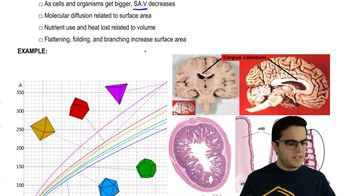
How does surface area to volume ratio affect homeostasis in animals?
A higher surface area to volume ratio allows for more efficient exchange of materials, which is important for maintaining homeostasis, especially in smaller animals.
What structural adaptations do animals use to increase surface area for exchange?
Animals use flattening, folding, and branching to increase surface area for exchange. Examples include folds in the brain, villi and microvilli in the intestine, and branching in the vascular system.
How do metabolic rates differ between endotherms and ectotherms?
Endotherms have higher metabolic rates because they generate body heat internally. Ectotherms rely mainly on external sources for heat and thus have lower metabolic rates.
What is the difference between basal metabolic rate and standard metabolic rate?
Basal metabolic rate refers to the minimum energy consumption of an endotherm at rest. Standard metabolic rate is the minimum energy consumption of an ectotherm at rest.
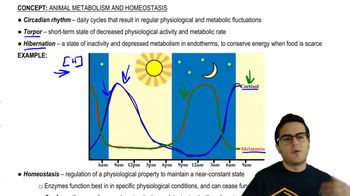
How do cortisol and melatonin levels fluctuate during a typical day?
Cortisol levels peak in the morning and decrease throughout the day, while melatonin levels are low during the day and rise at night to promote sleep. These fluctuations are part of circadian rhythms.
What is torpor and how does it differ from hibernation?
Torpor is a short-term state of decreased physiological activity and metabolic rate. Hibernation is a longer-term state of depressed metabolic activity, typically lasting through winter.
What are the main components of a generic homeostatic system?
A homeostatic system includes a set point, sensor, integrator, and effector. The sensor detects changes, the integrator decides on a response, and the effector acts to restore balance.
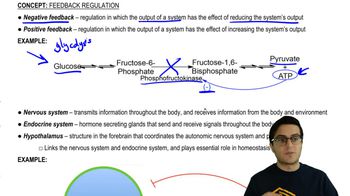
How does negative feedback regulate glycolysis in cellular respiration?
ATP produced during glycolysis inhibits the enzyme phosphofructokinase, shutting down the pathway. This prevents excess ATP production and conserves resources.
What is the HPA axis and how does it exemplify negative feedback?
The HPA axis involves the hypothalamus, pituitary, and adrenal glands in stress hormone regulation. Cortisol produced by the adrenal cortex feeds back to inhibit further hormone release from the hypothalamus and pituitary.
 Back
Back
 07:47
07:47