Skip to main content
General Biology
My Course
Learn
Exam Prep
AI Tutor
Study Guides
Textbook Solutions
Flashcards
Explore
Try the app
My Course
Learn
Exam Prep
AI Tutor
Study Guides
Textbook Solutions
Flashcards
Explore
Try the app
Back
Origin of Life definitions
You can tap to flip the card.
Common Ancestor
You can tap to flip the card.
👆
Common Ancestor
A shared origin point for all life, possessing complex features like hundreds of genes, DNA, RNA, and ribosomes.
Track progress
Control buttons has been changed to "navigation" mode.
1/14
Related flashcards
Related practice
Recommended videos
Origin of Life quiz #1
Origin of Life
1 Term
Origin of Life quiz #2
Origin of Life
12 Terms
Origin of Life quiz #3
Origin of Life
10 Terms
24. History of Life on Earth
1 topic
3 problems
Chapter
Jason
03:23
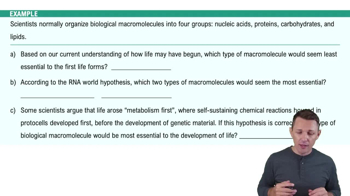
Origin of Life Example 1
2550
views
22
rank
06:38
Events that Lead to the Formation of Cells
3166
views
43
rank
1
comments
Terms in this set (14)
Hide definitions
Common Ancestor
A shared origin point for all life, possessing complex features like hundreds of genes, DNA, RNA, and ribosomes.
Abiotic Synthesis
Formation of organic molecules from non-living precursors, such as methane and ammonia, under early Earth conditions.
Amino Acids
Organic molecules that serve as building blocks for proteins, shown to form under prebiotic conditions.
Alkaline Hydrothermal Vents
Oceanic geological structures with basic chemistry, proposed as sites for the origin of organic molecules.
Miller-Urey Experiment
A laboratory simulation of early Earth conditions that produced amino acids from simple gases and electrical sparks.
Macromolecules
Large biological molecules, such as proteins and nucleic acids, formed by the polymerization of smaller units.
Polymerization
Process where small molecules join to create larger, chain-like structures, essential for forming proteins and nucleic acids.
Protocells
Membrane-bound vesicles capable of capturing and replicating molecules, considered precursors to true cells.
Vesicles
Membrane-bound bubbles formed from phospholipids, able to encapsulate molecules and undergo simple division.
Phospholipids
Molecules that spontaneously assemble into bilayers, forming the structural basis of cellular membranes.
RNA World Hypothesis
A proposal that early life relied on RNA for both catalysis and genetic information before the evolution of DNA.
Ribozymes
RNA molecules with catalytic activity, capable of speeding up chemical reactions and possibly self-replication.
Genetic Information
Encoded instructions within molecules like RNA or DNA, necessary for inheritance and biological function.
Natural Selection
A process where heritable traits become more common in a population due to differential survival and reproduction.
 BackBack
 03:23
03:23