What is the main criterion for defining species under the biological species concept?
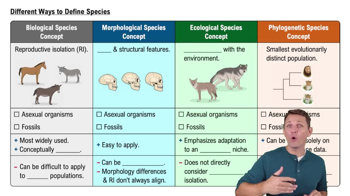
The biological species concept defines species based on reproductive isolation, meaning members of different species cannot successfully interbreed.
Why is the biological species concept difficult to apply to asexual organisms?
It is difficult because asexual organisms do not reproduce by mating, so reproductive isolation cannot be assessed.
What is a major limitation of using the biological species concept for fossils?
The biological species concept cannot be applied to fossils because it is impossible to determine if extinct organisms could interbreed.
How does the morphological species concept define a species?
The morphological species concept defines species based on differences in shape and structural features.
Why is the morphological species concept useful for classifying fossils?
It is useful because fossils can be grouped by their physical structures, which are often the only available evidence.
What is a potential drawback of the morphological species concept?
A drawback is that it can be subjective, as different scientists may disagree on whether differences are significant enough to define a new species.
How does the ecological species concept define species?
The ecological species concept defines species based on their interactions with the environment and their ecological niche.
Can the ecological species concept be applied to asexual organisms? Why or why not?
Yes, because asexual organisms also interact with their environment and occupy ecological niches.
What is a limitation of the ecological species concept when applied to fossils?
It is limited because ecological interactions are hard to infer directly from fossil evidence.
What is the main idea behind the phylogenetic species concept?
The phylogenetic species concept identifies species as the smallest evolutionarily distinct populations, often determined by unique branches on a phylogenetic tree.
Why is DNA sequence data important for the phylogenetic species concept?
DNA sequence data allows scientists to build phylogenetic trees and identify distinct evolutionary lineages, even for organisms with little other information.
Can the phylogenetic species concept be used for asexual organisms and fossils?
Yes, it can be used for asexual organisms and, to some extent, for fossils, though fossil data may not always provide enough detail.
What is a criticism of the phylogenetic species concept?
A criticism is that it may split populations into more species than is practical or useful, especially when differences are minor.
Why might different species concepts not always agree on what constitutes a species?
Different concepts focus on different criteria (reproduction, morphology, ecology, or evolutionary history), so they may classify the same organisms differently.
What is a key reason for using multiple species concepts in biology?
Multiple concepts are used because each has strengths and weaknesses, and some are better suited for certain organisms or research questions than others.
 Back
Back
 03:42
03:42