Skip to main content
General Biology
My Course
Learn
Exam Prep
AI Tutor
Study Guides
Textbook Solutions
Flashcards
Explore
Try the app
My Course
Learn
Exam Prep
AI Tutor
Study Guides
Textbook Solutions
Flashcards
Explore
Try the app
Back
Population Sampling Methods definitions
You can tap to flip the card.
Transect
You can tap to flip the card.
👆
Transect
A line of known position and length through a habitat, used to count organisms along or near it for population estimates.
Track progress
Control buttons has been changed to "navigation" mode.
1/15
Related flashcards
Related practice
Recommended videos
Population Sampling Methods exam
Population Sampling Methods
28 Terms
Population Sampling Methods quiz #1
Population Sampling Methods
17 Terms
50. Population Ecology
1 topic
3 problems
Chapter
Jason
Guided course
03:12
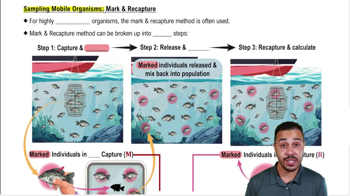
Sampling Mobile Organisms: Mark & Recapture
1721
views
6
rank
Guided course
01:54
Population Sampling Methods Example 1
1622
views
8
rank
Guided course
02:31
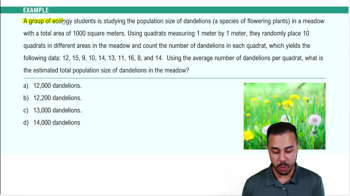
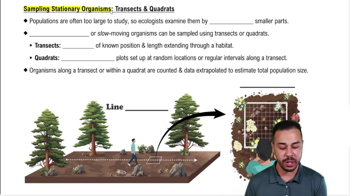
Sampling Stationary Organisms: Transects & Quadrats
1820
views
12
rank
Terms in this set (15)
Hide definitions
Transect
A line of known position and length through a habitat, used to count organisms along or near it for population estimates.
Quadrat
A rectangular or square plot placed randomly or at intervals to count organisms within its boundaries for sampling.
Population Size
The total number of individuals in a group, often estimated using sampling methods rather than direct counting.
Mark and Recapture
A method for estimating numbers of mobile organisms by capturing, marking, releasing, and recapturing individuals.
Genetic Diversity
The degree of genetic variation among individuals, used to infer whether a group is large or small.
Sampling
The process of examining a subset of a group to make inferences about the whole, especially when direct study is impractical.
Stationary Organism
A living thing that does not move or moves very slowly, making it suitable for transect or quadrat studies.
Mobile Organism
A living thing that moves frequently, requiring specialized methods like mark and recapture for study.
Equation mn=rc
A formula relating marked and recaptured individuals to estimate total numbers in a group.
Assumption
A condition that must be met for a method, such as mark and recapture, to yield accurate results.
Extrapolation
The process of using data from a sample to estimate characteristics of an entire group.
Molecular Tool
A technique using DNA analysis to assess group size by examining genetic relationships among individuals.
Habitat
The natural environment where a group lives and sampling methods are applied.
Population Density
The number of individuals per unit area, often inferred from sampling or genetic data.
Random Sampling
A technique where sample locations are chosen by chance to avoid bias in estimating group characteristics.
 BackBack
 03:12
03:12