Skip to main content
General Biology
My Course
Learn
Exam Prep
AI Tutor
Study Guides
Textbook Solutions
Flashcards
Explore
Try the app
My Course
Learn
Exam Prep
AI Tutor
Study Guides
Textbook Solutions
Flashcards
Explore
Try the app
Back
Porifera and Cnideria exam
You can tap to flip the card.
Porifera
You can tap to flip the card.
👆
Porifera
A phylum of hermaphroditic filter feeders, commonly known as sponges, that reproduce both sexually and asexually.
Track progress
Control buttons has been changed to "navigation" mode.
1/28
Related flashcards
Related practice
Recommended videos
Porifera and Cnideria definitions
Porifera and Cnideria
15 Terms
Porifera and Cnideria quiz #1
Porifera and Cnideria
15 Terms
Porifera and Cnideria quiz #2
Porifera and Cnideria
19 Terms
Porifera and Cnideria
31. Invertebrates
3 problems
Topic
Jason
Lophotrochozoans
31. Invertebrates
3 problems
Topic
Jason
31. Invertebrates
4 topics
6 problems
Chapter
Jason
Guided course
10:21
Porifera and Cnideria
4739
views
71
rank
1
comments
Terms in this set (28)
Hide definitions
Porifera
A phylum of hermaphroditic filter feeders, commonly known as sponges, that reproduce both sexually and asexually.
Cnidaria
A phylum that includes jellyfish, characterized by a radial body plan and a gastrovascular cavity for nutrient absorption.
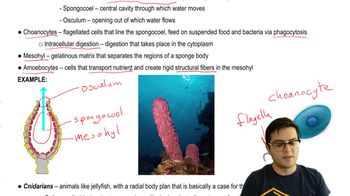
Spongocoel
The central cavity in sponges, lined with choanocytes for feeding through phagocytosis.
What are choanocytes?
Flagellated cells in sponges that capture food particles and bacteria for feeding through phagocytosis.
Cnidocytes
Specialized stinging cells in cnidarians that contain nematocysts for capturing prey.
What is the function of nematocysts?
To shoot out a penetrating barb that stings and immobilizes prey, allowing cnidarians to capture and eat it.
Polyp
One of the two body forms of cnidarians, characterized by a cylindrical body and tentacles, often attached to a surface.
Medusa
The free-swimming, bell-shaped body form of cnidarians, with tentacles hanging down.
What is the mesohyl?
A gelatinous matrix within sponges that separates different regions of the sponge body and contains amoebocytes.
Amoebocytes
Cells in sponges that create structural fibers and transport nutrients.
Gastrovascular cavity
A central cavity in cnidarians responsible for digestion and nutrient distribution.
What is a hydrostatic skeleton?
A structure in cnidarians where fluid pressure within the body cavity provides support and shape.
Hermaphroditic
An organism that has both male and female reproductive organs.
What are Anthozoa?
A class of cnidarians that includes corals and sea anemones, often with calcium carbonate exoskeletons.
Filter feeders
Organisms that feed by straining suspended matter and food particles from water.
What is the osculum?
The opening in a sponge through which water exits after passing through the spongocoel.
Radial symmetry
A body plan in which any longitudinal cut through the organism's central axis results in identical halves.
Intracellular digestion
The process by which food is digested within the cells, as seen in sponges.
What is the primary function of the gastrovascular cavity in cnidarians?
To digest food and distribute nutrients throughout the organism.
Calcium carbonate exoskeleton
A hard, external structure made of calcium carbonate, found in some cnidarians like corals.
What is phagocytosis?
The process by which cells engulf and digest particles, used by choanocytes in sponges.
Sessile
Describes an organism that is fixed in one place and does not move, although some polyps can detach to escape predators.
What is the main difference between polyps and medusae?
Polyps are usually attached to a surface with tentacles facing upward, while medusae are free-swimming with tentacles hanging down.
Cnidarian
An animal belonging to the phylum Cnidaria, which includes jellyfish, corals, and sea anemones.
What is the role of flagella in choanocytes?
To create water currents and capture food particles for feeding.
Exoskeleton
A rigid external covering that provides support and protection, found in some cnidarians like corals.
What is the significance of the radial body plan in cnidarians?
It allows the organism to interact with the environment from all directions, aiding in feeding and defense.
Phylum
A taxonomic rank in the biological classification system, grouping together organisms with similar characteristics.
 BackBack
 10:21
10:21