Skip to main content
General Biology
My Course
Learn
Exam Prep
AI Tutor
Study Guides
Textbook Solutions
Flashcards
Explore
Try the app
My Course
Learn
Exam Prep
AI Tutor
Study Guides
Textbook Solutions
Flashcards
Explore
Try the app
Back
Prokaryotic & Eukaryotic Cells quiz #4
You can tap to flip the card.
What is the major difference between bacterial chromosomes and eukaryotic chromosomes?
You can tap to flip the card.
👆
What is the major difference between bacterial chromosomes and eukaryotic chromosomes?
Bacterial chromosomes are circular, while eukaryotic chromosomes are linear.
Track progress
Control buttons has been changed to "navigation" mode.
1/39
Related flashcards
Related practice
Recommended videos
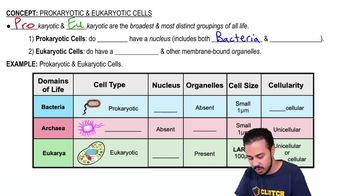
Prokaryotic & Eukaryotic Cells definitions
Prokaryotic & Eukaryotic Cells
18 Terms
Prokaryotic & Eukaryotic Cells quiz #1
Prokaryotic & Eukaryotic Cells
51 Terms
Prokaryotic & Eukaryotic Cells exam
Prokaryotic & Eukaryotic Cells
29 Terms
Prokaryotic & Eukaryotic Cells
5. Cell Components
7 problems
Topic
Jason
Introduction to Eukaryotic Organelles
5. Cell Components
5 problems
Topic
Jason
5. Cell Components
9 topics
15 problems
Chapter
Brendan
Guided course
04:26
Recap: Prokaryotic vs. Eukaryotic Cells
20482
views
340
rank
Guided course
05:54
Prokaryotic & Eukaryotic Cells
34781
views
742
rank
4
comments
Guided course
03:54
Features of Bacterial Cells
24547
views
424
rank
1
comments
Terms in this set (39)
Hide definitions
What is the major difference between bacterial chromosomes and eukaryotic chromosomes?
Bacterial chromosomes are circular, while eukaryotic chromosomes are linear.
Which of these is the best model of a prokaryotic cell?
A bacterial cell is the best model of a prokaryotic cell.
Which type of cell does not contain a nucleus?
Prokaryotic cells do not contain a nucleus.
How are animal cells and plant cells different?
Animal cells lack a cell wall and chloroplasts, which plant cells have.
Which two components are most likely found in both viruses and prokaryotic cells?
Both have genetic material and a protein coat.
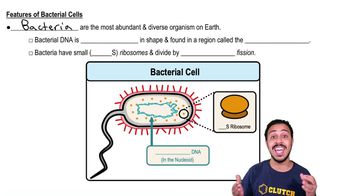
Where is a bacterial cell's DNA found?
A bacterial cell's DNA is found in the nucleoid region.
What are the three principles of cell theory?
1. All living organisms are composed of cells. 2. The cell is the basic unit of life. 3. All cells arise from pre-existing cells.
Which characteristic is shared by all prokaryotic and eukaryotic organisms?
All have a cell membrane and ribosomes.
What cellular components are found in both eukaryotic and prokaryotic cells?
Both have a cell membrane and ribosomes.
What is the most important factor that limits the size of cells?
Surface area to volume ratio is the most important factor.
Which organelle is present in both prokaryotic and eukaryotic cells?
Ribosomes are present in both prokaryotes and eukaryotes.
What is the difference between a prokaryotic and eukaryotic ribosome?
Prokaryotic ribosomes are 70S, while eukaryotic ribosomes are 80S.
Which is true regarding all bacterial cells?
All bacterial cells are prokaryotic and lack a nucleus.
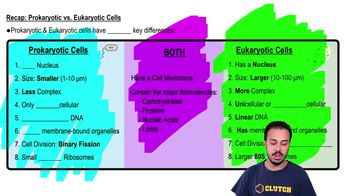
What is the difference between prokaryotic cells and eukaryotic cells?
Prokaryotic cells lack a nucleus and membrane-bound organelles, while eukaryotic cells have both.
Which statement applies to eukaryotic cells but not to prokaryotic cells?
Eukaryotic cells have a nucleus and membrane-bound organelles.
What is the main function of the cell wall in a plant cell?
The cell wall provides structural support and protection.
In eukaryotes, where is the DNA located?
In eukaryotes, DNA is located inside the nucleus.
What structures are typically present in both plant and animal cells?
Both have a nucleus, cell membrane, and various organelles.
What feature do all eukaryotic and prokaryotic cells share?
All have a cell membrane and ribosomes.
Which of these is a hallmark of eukaryotic cells?
Presence of a nucleus is a hallmark of eukaryotic cells.
Which cell lacks a nucleus?
Prokaryotic cells lack a nucleus.
What do all eukaryotes have that prokaryotes do not?
Eukaryotes have a nucleus and membrane-bound organelles.
What feature does a prokaryotic cell have that an animal cell does not?
Prokaryotic cells have circular DNA, which animal cells do not.
Which domain consists of all organisms whose cells have true nuclei?
Domain Eukarya consists of organisms with true nuclei.
Which statement below is correct when comparing plant and animal cells?
Plant cells have a cell wall and chloroplasts, while animal cells do not.
Why are cells small?
Cells are small to maintain a favorable surface area to volume ratio for efficient nutrient exchange.
What is a major difference between prokaryotic and eukaryotic cells?
Prokaryotic cells lack a nucleus and membrane-bound organelles, while eukaryotic cells have both.
Which statement best compares eukaryotic cells and prokaryotic cells?
Eukaryotic cells have a nucleus and membrane-bound organelles, while prokaryotic cells do not.
What do eukaryotic cells have that prokaryotic cells do not?
Eukaryotic cells have a nucleus and membrane-bound organelles.
What is the difference between eukaryotic cells and prokaryotic cells?
Eukaryotic cells have a nucleus and membrane-bound organelles, while prokaryotic cells do not.
Which is present only in eukaryotic cells?
A nucleus is present only in eukaryotic cells.
Which of these do all prokaryotes and eukaryotes have?
Both have a cell membrane and ribosomes.
What are the three principles of cell theory?
1. All living organisms are composed of cells. 2. The cell is the basic unit of life. 3. All cells arise from pre-existing cells.
What molecule or structure may be found in eukaryotic cells but not in bacteria?
Eukaryotic cells may have a nucleus, which bacteria do not.
What is a part of the cell theory?
All living organisms are composed of cells.
What feature occurs in prokaryotic and in some eukaryotic cells?
Both can have a cell wall.
What is found exclusively in prokaryotic cells?
Circular DNA is found exclusively in prokaryotic cells.
What is the primary difference between prokaryotic and eukaryotic cells?
Prokaryotic cells lack a nucleus and membrane-bound organelles, while eukaryotic cells have both.
Which eukaryotes are traditionally studied by microbiologists?
Fungi and protists are eukaryotes studied by microbiologists.
 BackBack

 04:26
04:26