Skip to main content
General Biology
My Course
Learn
Exam Prep
AI Tutor
Study Guides
Textbook Solutions
Flashcards
Explore
Try the app
My Course
Learn
Exam Prep
AI Tutor
Study Guides
Textbook Solutions
Flashcards
Explore
Try the app
Back
Prokaryotic & Eukaryotic Cells quiz #5
You can tap to flip the card.
Which are characteristics of a prokaryotic cell? Select three options.
You can tap to flip the card.
👆
Which are characteristics of a prokaryotic cell? Select three options.
1. Lack of nucleus 2. Circular DNA 3. Smaller size
Track progress
Control buttons has been changed to "navigation" mode.
1/40
Related flashcards
Related practice
Recommended videos
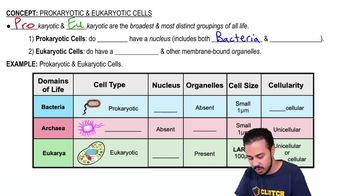
Prokaryotic & Eukaryotic Cells definitions
Prokaryotic & Eukaryotic Cells
18 Terms
Prokaryotic & Eukaryotic Cells quiz #1
Prokaryotic & Eukaryotic Cells
51 Terms
Prokaryotic & Eukaryotic Cells exam
Prokaryotic & Eukaryotic Cells
29 Terms
Prokaryotic & Eukaryotic Cells
5. Cell Components
7 problems
Topic
Jason
Introduction to Eukaryotic Organelles
5. Cell Components
5 problems
Topic
Jason
5. Cell Components
9 topics
15 problems
Chapter
Brendan
Guided course
04:26
Recap: Prokaryotic vs. Eukaryotic Cells
20482
views
340
rank
Guided course
05:54
Prokaryotic & Eukaryotic Cells
34781
views
742
rank
4
comments
Guided course
03:54
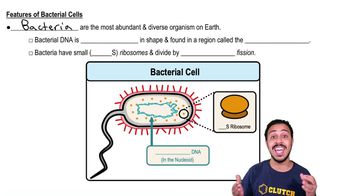
Features of Bacterial Cells
24547
views
424
rank
1
comments
Terms in this set (40)
Hide definitions
Which are characteristics of a prokaryotic cell? Select three options.
1. Lack of nucleus 2. Circular DNA 3. Smaller size
Which of these best explains the difference between eukaryotes and prokaryotes?
Eukaryotes have a nucleus and membrane-bound organelles, while prokaryotes do not.
Which is part of the cell theory?
All living organisms are composed of cells.
What are the differences between prokaryotes and eukaryotes?
Prokaryotes lack a nucleus and membrane-bound organelles, while eukaryotes have both.
What is the main difference between a prokaryotic cell and an eukaryotic cell?
Prokaryotic cells lack a nucleus and membrane-bound organelles, while eukaryotic cells have both.
How do you think plant cells differ from animal cells?
Plant cells have a cell wall and chloroplasts, while animal cells do not.
Which type of cell does not contain organelles?
Prokaryotic cells do not contain membrane-bound organelles.
What are the parts of the cell theory?
1. All living organisms are composed of cells. 2. The cell is the basic unit of life. 3. All cells arise from pre-existing cells.
What are the three principles of the cell theory?
1. All living organisms are composed of cells. 2. The cell is the basic unit of life. 3. All cells arise from pre-existing cells.
In a eukaryotic cell, where is the DNA located?
In a eukaryotic cell, DNA is located inside the nucleus.
What structure do prokaryotes not have?
Prokaryotes do not have a nucleus.
Which groups of organisms belong in the domain Eukarya?
Animals, plants, fungi, and protists belong in the domain Eukarya.
What structures are found in eukaryotic cells but not in prokaryotic cells?
Eukaryotic cells have a nucleus and membrane-bound organelles.
What feature is unique to bacterial cells compared to eukaryotic cells?
Bacterial cells have circular DNA.
What is the difference between cilia and flagella?
Cilia are short and numerous, while flagella are longer and fewer.
What structures do all cells have?
All cells have a cell membrane and ribosomes.
What type of cell is a bacterial cell?
A bacterial cell is a prokaryotic cell.
What is the difference between a prokaryotic and a eukaryotic cell?
Prokaryotic cells lack a nucleus and membrane-bound organelles, while eukaryotic cells have both.
Which of these sub-cellular structures is found in both eukaryotes and prokaryotes?
Ribosomes are found in both eukaryotes and prokaryotes.
Which of these is a defining characteristic in a eukaryotic cell?
Presence of a nucleus is a defining characteristic in a eukaryotic cell.
Which material would be used in a model of a eukaryotic cell but not a prokaryotic cell?
A nucleus would be used in a model of a eukaryotic cell but not a prokaryotic cell.
What is the main difference between a prokaryote and a eukaryote?
Prokaryotes lack a nucleus and membrane-bound organelles, while eukaryotes have both.
Which organism is prokaryotic?
Bacteria are prokaryotic organisms.
What are the three principles of the cell theory?
1. All living organisms are composed of cells. 2. The cell is the basic unit of life. 3. All cells arise from pre-existing cells.
What is the smallest unit of an organism that can carry out all the functions of life?
The cell is the smallest unit that can carry out all the functions of life.
Which structure would not be found in both prokaryotic and eukaryotic cells?
A nucleus would not be found in prokaryotic cells.
Which organelle is present in prokaryotic cells?
Ribosomes are present in prokaryotic cells.
What cellular process occurs in prokaryotes but not in eukaryotes?
Binary fission occurs in prokaryotes but not in eukaryotes.
What cellular structure do antibiotics typically target?
Antibiotics typically target the bacterial cell wall.
What structures are found in prokaryotic cells?
Prokaryotic cells have ribosomes and circular DNA.
What is one way that bacterial and archaeal cells differ from each other?
Bacterial cell walls contain peptidoglycan, while archaeal cell walls do not.
What structures are found in eukaryotic cells?
Eukaryotes have a nucleus and membrane-bound organelles.
Which components would be found in a eukaryotic cell but not in a prokaryotic cell?
A nucleus and membrane-bound organelles would be found in a eukaryotic cell but not in a prokaryotic cell.
What is true for all prokaryotic and eukaryotic organisms?
All have a cell membrane and ribosomes.
Prokaryotic cells are smaller than eukaryotic cells. What is a plausible explanation?
Prokaryotic cells are less complex and lack membrane-bound organelles, making them smaller.
Which structure can be found in both eukaryotic and prokaryotic cells?
Ribosomes can be found in both eukaryotic and prokaryotic cells.
Which one includes plant and animal cells?
Eukaryotic cells include plant and animal cells.
Which characteristic distinguishes a eukaryotic organism from a prokaryotic organism?
Eukaryotic organisms have a nucleus and membrane-bound organelles.
What are the differences between cell division in a prokaryote and in a eukaryote?
Prokaryotes divide by binary fission, while eukaryotes divide by mitosis and cytokinesis.
In eukaryotes, where is the DNA located?
In eukaryotes, DNA is located inside the nucleus.
 BackBack

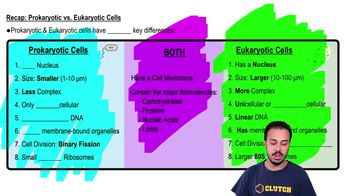
 04:26
04:26