Skip to main content
General Biology
My Course
Learn
Exam Prep
AI Tutor
Study Guides
Textbook Solutions
Flashcards
Explore
Try the app
My Course
Learn
Exam Prep
AI Tutor
Study Guides
Textbook Solutions
Flashcards
Explore
Try the app
Back
Prokaryotic Motility definitions
You can tap to flip the card.
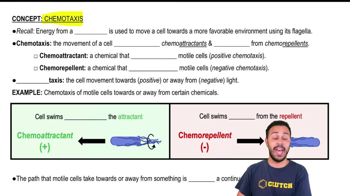
Chemotaxis
You can tap to flip the card.
👆
Chemotaxis
Movement of cells in response to chemical gradients, allowing navigation toward attractants or away from repellants.
Track progress
Control buttons has been changed to "navigation" mode.
1/15
Related flashcards
Related practice
Recommended videos
Prokaryotic Motility quiz #1
Prokaryotic Motility
2 Terms
Prokaryotic Motility quiz #2
Prokaryotic Motility
11 Terms
Prokaryotic Motility quiz #3
Prokaryotic Motility
10 Terms
Prokaryote Reproduction and Gene Exchange
26. Prokaryotes
3 problems
Topic
Jason
26. Prokaryotes
4 topics
10 problems
Chapter
Jason
Guided course
02:40
Prokaryotic Flagellar Structure
1944
views
14
rank
Guided course
03:21
Chemotaxis
2185
views
15
rank
Guided course
02:00
Introduction to Prokaryotic Flagella
1975
views
11
rank
Terms in this set (15)
Hide definitions
Chemotaxis
Movement of cells in response to chemical gradients, allowing navigation toward attractants or away from repellants.
Chemoattractant
A chemical substance that draws motile cells closer, guiding them toward more favorable environments.
Chemorepellant
A chemical substance that causes motile cells to move away, helping them avoid harmful conditions.
Positive Chemotaxis
Directional movement of cells toward higher concentrations of attractant chemicals.
Negative Chemotaxis
Directional movement of cells away from repellant chemicals, promoting survival.
Phototaxis
Cellular movement in response to light, either toward or away from a light source.
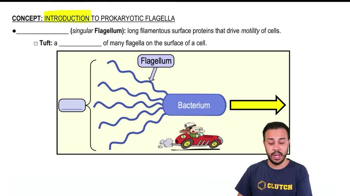
Flagella
Long, filamentous surface structures composed of protein, responsible for propelling prokaryotic cells.
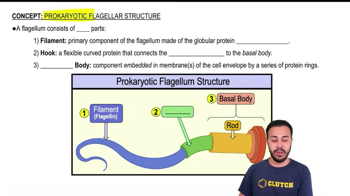
Flagellin
Globular protein forming the main structural component of the flagellar filament.
Filament
The primary, elongated part of a flagellum, built from flagellin, extending from the cell surface.
Hook
Flexible, curved protein structure connecting the filament to the basal body in prokaryotic flagella.
Basal Body
Complex structure with a rod and protein rings, anchoring the flagellum within the cell envelope.
Tuft
A group of multiple flagella clustered together on the surface of a prokaryotic cell.
Proton Motive Force
Electrochemical gradient of protons across a membrane, providing energy for flagellar rotation.
Motility
Ability of cells to move actively and efficiently through their environment.
Run and Tumble
Pattern of movement in motile cells, alternating between straight swimming and random reorientation.
 BackBack
 02:40
02:40