Skip to main content
General Biology
My Course
Learn
Exam Prep
AI Tutor
Study Guides
Textbook Solutions
Flashcards
Explore
Try the app
My Course
Learn
Exam Prep
AI Tutor
Study Guides
Textbook Solutions
Flashcards
Explore
Try the app
Back
Protist Life Cycles exam
You can tap to flip the card.
Alternation of generations
You can tap to flip the card.
👆
Alternation of generations
A life cycle involving both haploid (gametophyte) and diploid (sporophyte) stages, each with multicellular components.
Track progress
Control buttons has been changed to "navigation" mode.
1/27
Related flashcards
Related practice
Recommended videos
Protist Life Cycles definitions
Protist Life Cycles
15 Terms
Protist Life Cycles quiz #1
Protist Life Cycles
15 Terms
Protist Life Cycles quiz #2
Protist Life Cycles
10 Terms
Protist Life Cycles
27. Protists
4 problems
Topic
KeyshawnDavis
Protist Lineages
27. Protists
7 problems
Topic
Jason
27. Protists
3 topics
5 problems
Chapter
Nicole
Guided course
04:56
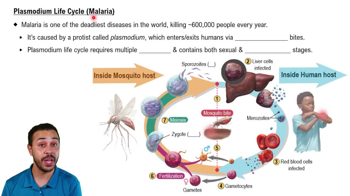
Plasmodium Life Cycle (Malaria)
2132
views
14
rank
Guided course
06:28
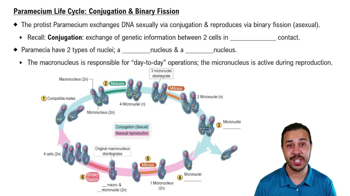
Paramecium Life Cycle: Conjugation & Asexual Reproduction
2207
views
9
rank
Guided course
01:22
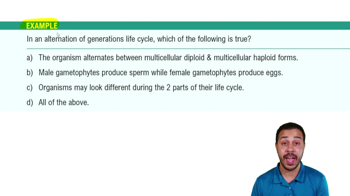
Protist Life Cycles Example 2
1671
views
10
rank
Terms in this set (27)
Hide definitions
Alternation of generations
A life cycle involving both haploid (gametophyte) and diploid (sporophyte) stages, each with multicellular components.
What is the haploid multicellular stage in alternation of generations called?
Gametophyte
Sporophyte
The diploid multicellular stage in alternation of generations that undergoes meiosis to produce spores.
What do gametophytes produce?
Gametes
Heteromorphic
When the sporophyte and gametophyte stages are structurally different.
Isomorphic
When the sporophyte and gametophyte stages look the same.
What is the only diploid stage in a haploid-dominant life cycle?
Zygote
What process does the zygote undergo in a haploid-dominant life cycle?
Meiosis
Diploid-dominant life cycle
A life cycle where the only haploid cells are the gametes.
In a diploid-dominant life cycle, what do mature cells undergo to form gametes?
Meiosis
What is the role of spores in alternation of generations?
Spores are units of asexual reproduction that are generally haploid and unicellular.
What happens after gametes fuse in alternation of generations?
Fertilization occurs, forming a zygote.
What does the zygote form after undergoing mitosis in alternation of generations?
Sporophyte
What is the main difference between haploid-dominant and diploid-dominant life cycles?
In haploid-dominant, the zygote undergoes meiosis directly; in diploid-dominant, the zygote undergoes mitosis to form the organism.
What type of organisms can have haploid-dominant life cycles?
Unicellular or multicellular organisms
What is the process by which haploid cells reproduce asexually in haploid-dominant life cycles?
Mitosis and cell division
What is the only haploid part of a diploid-dominant organism's life cycle?
Gametes
What is the significance of understanding eukaryotic life cycles?
It is crucial for grasping reproductive strategies in various organisms, including plants and protists.
What happens to the zygote in a diploid-dominant life cycle?
It undergoes mitosis to form the organism.
What is the process by which gametophytes form from spores?
Mitosis
What is the main reproductive strategy in haploid-dominant life cycles?
Asexual reproduction through mitosis and cell division
What is the role of meiosis in diploid-dominant life cycles?
To form gametes from mature cells
What is the outcome of fertilization in alternation of generations?
Formation of a zygote
What is the structural difference between heteromorphic and isomorphic organisms?
Heteromorphic organisms have different forms for sporophyte and gametophyte stages, while isomorphic organisms have the same form for both stages.
What is the primary characteristic of a diploid-dominant life cycle?
The organism is primarily diploid, with gametes being the only haploid cells.
What is the primary characteristic of a haploid-dominant life cycle?
The organism is primarily haploid, with the zygote being the only diploid stage.
What is the process by which gametes are formed in haploid-dominant life cycles?
Mitosis
 BackBack

 04:56
04:56