Skip to main content
General Biology
My Course
Learn
Exam Prep
AI Tutor
Study Guides
Textbook Solutions
Flashcards
Explore
Try the app
My Course
Learn
Exam Prep
AI Tutor
Study Guides
Textbook Solutions
Flashcards
Explore
Try the app
Back
Steps to DNA Cloning exam
You can tap to flip the card.
Recombinant DNA
You can tap to flip the card.
👆
Recombinant DNA
A single DNA molecule that contains DNA from two different sources.
Track progress
Control buttons has been changed to "navigation" mode.
1/29
Related flashcards
Related practice
Recommended videos
Steps to DNA Cloning definitions
Steps to DNA Cloning
20 Terms
Steps to DNA Cloning quiz #1
Steps to DNA Cloning
15 Terms
Steps to DNA Cloning
18. Biotechnology
6 problems
Topic
Jason
Introduction to Polymerase Chain Reaction
18. Biotechnology
3 problems
Topic
Jason
18. Biotechnology - Part 1 of 2
5 topics
10 problems
Chapter
Jason
18. Biotechnology - Part 2 of 2
5 topics
9 problems
Chapter
Jason
Guided course
04:42
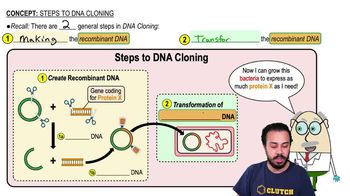
Steps to DNA Cloning
6191
views
60
rank
Guided course
04:58
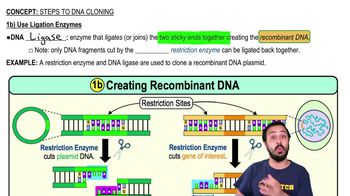
1b) Use Ligation Enzymes
4858
views
46
rank
Guided course
03:27
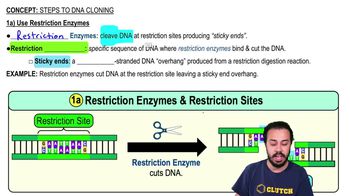
1a) Use Restriction Enzymes
5577
views
45
rank
1
comments
Terms in this set (29)
Hide definitions
Recombinant DNA
A single DNA molecule that contains DNA from two different sources.
What is the first step in DNA cloning?
Creating the recombinant DNA molecule.
Restriction Enzymes
Enzymes that cut DNA at specific restriction sites, producing sticky ends.
What is the role of DNA ligase in DNA cloning?
It covalently joins the DNA fragments, acting like glue.
Transformation
The process by which bacteria uptake recombinant DNA from their environment.
What are sticky ends?
Single-stranded DNA overhangs produced by restriction enzyme cuts.
Transgenic Organism
An organism that has received and expresses recombinant DNA from a different species.
What is the purpose of using phenotypic markers in DNA cloning?
To confirm a positive transformation, such as antibiotic resistance.
Cloning Vector
A DNA molecule used to carry foreign genetic material into a host cell.
What is the second step in DNA cloning?
Transforming the recombinant DNA into bacteria.
Insulin Production
A medical application of DNA cloning where transgenic bacteria produce human insulin.
What is a restriction site?
A specific DNA sequence where a restriction enzyme binds and cuts the DNA.
DNA Cloning
A process involving creating recombinant DNA and transforming it into bacteria.
What is the significance of sticky ends in DNA cloning?
They allow complementary base pairing, facilitating the ligation of DNA fragments.
Antibiotic Resistance
A phenotypic marker used to confirm successful transformation in bacteria.
What is the role of a bacterial plasmid in DNA cloning?
It serves as a vector to carry the gene of interest into the host cell.
Gene of Interest
A specific gene that is inserted into a plasmid for cloning purposes.
What does the term 'ligation' refer to in DNA cloning?
The process of joining DNA fragments together using DNA ligase.
Therapeutic Proteins
Proteins produced through DNA cloning for medical treatments, such as insulin.
What is the purpose of creating recombinant DNA?
To combine DNA from different sources for cloning and expression in host cells.
E. Coli
A common bacterial host used in DNA cloning to express recombinant genes.
What is the outcome of successful DNA transformation?
The bacteria express the foreign gene, producing the desired protein.
Molecular Scissors
A metaphor for restriction enzymes that cut DNA at specific sites.
What is the function of a cloning vector?
To introduce foreign DNA into a host cell for replication and expression.
Diabetes
A condition treated with insulin produced by transgenic bacteria through DNA cloning.
What is the significance of the transformation step in DNA cloning?
It allows the recombinant DNA to be taken up by bacteria, enabling gene expression.
Sticky Ends
Overhanging sequences of single-stranded DNA created by restriction enzyme cuts.
What is the role of restriction enzymes in creating recombinant DNA?
They cut DNA at specific sites to create fragments with sticky ends for ligation.
DNA Ligase
An enzyme that joins DNA fragments by forming covalent bonds.
 BackBack
 04:42
04:42