Skip to main content
General Biology
My Course
Learn
Exam Prep
AI Tutor
Study Guides
Textbook Solutions
Flashcards
Explore
Try the app
My Course
Learn
Exam Prep
AI Tutor
Study Guides
Textbook Solutions
Flashcards
Explore
Try the app
Back
Terrestrial Biomes: Near Equator definitions
You can tap to flip the card.
Tropical Rainforest
You can tap to flip the card.
👆
Tropical Rainforest
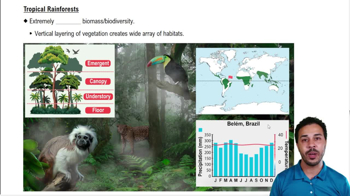
Biome near the equator with high rainfall, consistent warmth, dense vegetation, and vertical habitat layers supporting vast biodiversity.
Track progress
Control buttons has been changed to "navigation" mode.
1/15
Related flashcards
Related practice
Recommended videos
Terrestrial Biomes: Near Equator exam
Terrestrial Biomes: Near Equator
28 Terms
Terrestrial Biomes: Near Equator quiz #1
Terrestrial Biomes: Near Equator
10 Terms
48. Ecology
1 topic
3 problems
Chapter
Nicole
Guided course
03:03
Terrestrial Biomes: Near Equator Example 1
1346
views
5
rank
Guided course
01:02
Savannas (Tropical Grasslands)
1522
views
14
rank
Guided course
01:22
Tropical Rainforests
1538
views
13
rank
Terms in this set (15)
Hide definitions
Tropical Rainforest
Biome near the equator with high rainfall, consistent warmth, dense vegetation, and vertical habitat layers supporting vast biodiversity.
Savannah
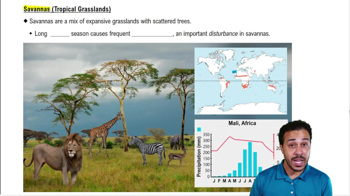
Tropical grassland with scattered trees, marked by a long dry season, frequent wildfires, and adaptations to drought.
Desert
Region with extremely low precipitation, sparse vegetation, low biomass, and highly variable temperatures.
Biodiversity
Rich variety of plant and animal species, especially prominent in equatorial rainforests.
Vertical Layering
Arrangement of vegetation in distinct strata, creating multiple habitats within dense forests.
Biomass
Total mass of living organisms in a given area, highest in rainforests and lowest in deserts.
Precipitation
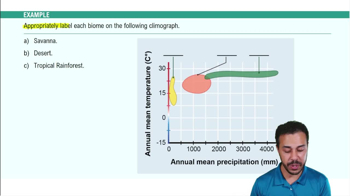
Amount of rainfall or moisture received, shaping the climate and vegetation of each biome.
Wildfire
Natural disturbance common in savannahs, influencing species adaptations and ecosystem structure.
Adaptation
Specialized trait enabling survival in challenging conditions like drought or fire.
Habitat
Specific environment within a biome where organisms live, shaped by climate and vegetation.
Net Productivity
Rate of biomass production, typically low in deserts due to limited water and vegetation.
Dry Season
Extended period with minimal rainfall, characteristic of savannahs and influencing fire frequency.
Equator
Imaginary line encircling Earth, near which tropical rainforests and savannahs are concentrated.
Vegetation
Plant life present in a biome, ranging from dense forests to sparse desert flora.
Climate Graph
Visual representation of temperature and precipitation patterns for a specific region or biome.
 BackBack
 03:03
03:03