Skip to main content
General Biology
My Course
Learn
Exam Prep
AI Tutor
Study Guides
Textbook Solutions
Flashcards
Explore
Try the app
My Course
Learn
Exam Prep
AI Tutor
Study Guides
Textbook Solutions
Flashcards
Explore
Try the app
Back
Terrestrial Biomes: Northern Regions definitions
You can tap to flip the card.
Boreal Forest
You can tap to flip the card.
👆
Boreal Forest
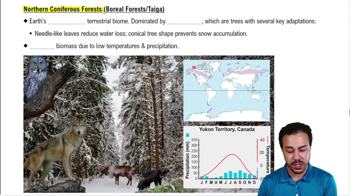
Earth's largest land biome, dominated by conifer trees with adaptations for cold, dry climates and low biodiversity.
Track progress
Control buttons has been changed to "navigation" mode.
1/15
Related flashcards
Related practice
Recommended videos
Terrestrial Biomes: Northern Regions exam
Terrestrial Biomes: Northern Regions
29 Terms
Terrestrial Biomes: Northern Regions quiz #1
Terrestrial Biomes: Northern Regions
10 Terms
48. Ecology
1 topic
3 problems
Chapter
Nicole
Guided course
00:58
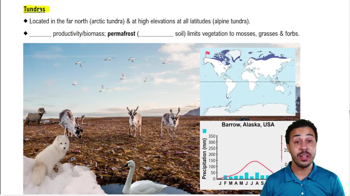
Tundras
1445
views
10
rank
Guided course
05:07
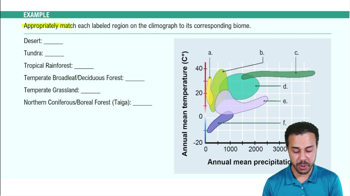
Terrestrial Biomes: Northern Regions Example 1
1361
views
6
rank
Guided course
01:03
Northern Coniferous Forests (Boreal Forests/Taiga)
1607
views
7
rank
Terms in this set (15)
Hide definitions
Boreal Forest
Earth's largest land biome, dominated by conifer trees with adaptations for cold, dry climates and low biodiversity.
Conifer
Tree type with needle-like leaves and cone-shaped structure, adapted to minimize water loss and shed snow.
Needle-like Leaf
Leaf structure that reduces water loss, common in trees adapted to cold, dry environments.
Taiga
Another name for northern coniferous forests, spanning vast northern regions with low temperatures.
Biomass
Total mass of living organisms in a given area, typically low in cold, northern biomes.
Precipitation
Amount of water, in any form, falling from the atmosphere, often limited in northern biomes.
Tundra
Biome with treeless landscapes, extreme cold, and vegetation limited to mosses, grasses, and forbs.
Arctic Tundra
Treeless region found in Earth's far north, marked by permafrost and minimal plant diversity.
Alpine Tundra
High-elevation biome with tundra-like conditions, found on mountain tops at various latitudes.
Permafrost
Permanently frozen soil layer that restricts tree growth and shapes tundra ecosystems.
Productivity
Rate at which plants produce biomass, typically low in cold, northern biomes due to harsh conditions.
Moss
Small, non-vascular plant commonly found in tundra regions, adapted to survive in cold, wet soils.
Forb
Herbaceous flowering plant, distinct from grasses, often present in tundra vegetation.
Ecological Balance
State of equilibrium among organisms and their environment, crucial for sustaining life in harsh biomes.
Biodiversity
Variety of living species in an ecosystem, generally limited in northern biomes due to extreme climates.
 BackBack
 00:58
00:58