Skip to main content
General Biology
My Course
Learn
Exam Prep
AI Tutor
Study Guides
Textbook Solutions
Flashcards
Explore
Try the app
My Course
Learn
Exam Prep
AI Tutor
Study Guides
Textbook Solutions
Flashcards
Explore
Try the app
Back
Terrestrial Biomes: Temperate Regions definitions
You can tap to flip the card.
Chaparral
You can tap to flip the card.
👆
Chaparral
Ecosystem dominated by shrubs and small trees, found in mid-latitude coastal regions with Mediterranean climates.
Track progress
Control buttons has been changed to "navigation" mode.
1/15
Related flashcards
Related practice
Recommended videos
Terrestrial Biomes: Temperate Regions exam
Terrestrial Biomes: Temperate Regions
29 Terms
Terrestrial Biomes: Temperate Regions quiz #1
Terrestrial Biomes: Temperate Regions
10 Terms
48. Ecology
1 topic
3 problems
Chapter
Nicole
Guided course
00:51
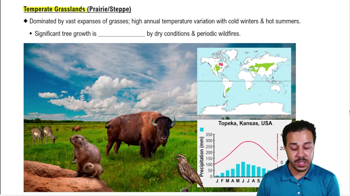
Temperate Grasslands (Prairie/Steppe)
1418
views
7
rank
Guided course
01:59
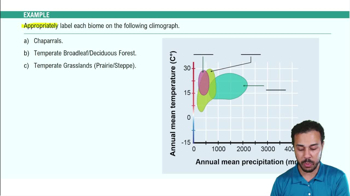
Terrestrial Biomes: Temperate Regions Example 1
1341
views
5
rank
Guided course
01:00
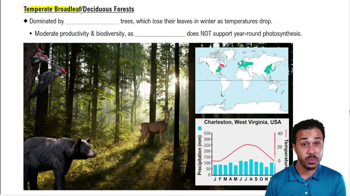
Temperate Broadleaf/Deciduous Forests
1291
views
10
rank
Terms in this set (15)
Hide definitions
Chaparral
Ecosystem dominated by shrubs and small trees, found in mid-latitude coastal regions with Mediterranean climates.
Mediterranean Climate
Climate type with hot, dry summers and mild, wet winters, common in certain coastal regions.
Wildfire
Frequent natural disturbance shaping plant and animal adaptations in shrublands and grasslands.
Temperate Grassland
Biome with vast grass expanses, high temperature variation, and moderate rainfall, limiting tree growth.
Prairie
North American term for temperate grasslands, characterized by extensive grasses and few trees.
Steppe
Eurasian term for temperate grasslands, marked by open, grassy landscapes and moderate rainfall.
Temperate Broadleaf Forest
Biome dominated by trees with broad leaves that are shed seasonally, found in temperate zones.
Deciduous Forest
Forest type where trees lose leaves in winter and regrow them in spring, supporting moderate biodiversity.
Biodiversity
Variety of living organisms present, moderate in temperate broadleaf forests due to seasonal changes.
Productivity
Rate of biomass generation, moderate in temperate forests due to seasonal leaf loss and regrowth.
Precipitation
Rainfall pattern influencing biome characteristics, moderate in grasslands and consistent in broadleaf forests.
Adaptation
Trait evolved by plants and animals to survive wildfires and climate extremes in temperate biomes.
Seasonality
Distinct seasonal changes, including cold winters and hot summers, shaping temperate biome dynamics.
Shrubland
Vegetation type dominated by shrubs, typical of chaparral regions with frequent fire disturbances.
Latitude
Geographic coordinate influencing biome distribution, with temperate regions around 35 degrees.
 BackBack
 00:51
00:51