Skip to main content
General Biology
My Course
Learn
Exam Prep
AI Tutor
Study Guides
Textbook Solutions
Flashcards
Explore
Try the app
My Course
Learn
Exam Prep
AI Tutor
Study Guides
Textbook Solutions
Flashcards
Explore
Try the app
Back
The Biological Species Concept definitions
You can tap to flip the card.
Biological Species Concept
You can tap to flip the card.
👆
Biological Species Concept
A framework that groups organisms based on their inability to exchange genes due to reproductive isolation.
Track progress
Control buttons has been changed to "navigation" mode.
1/15
Related flashcards
Related practice
Recommended videos
The Biological Species Concept exam
The Biological Species Concept
28 Terms
The Biological Species Concept quiz #2
The Biological Species Concept
12 Terms
The Biological Species Concept quiz #3
The Biological Species Concept
10 Terms
23. Speciation
1 topic
3 problems
Chapter
Jason
02:15
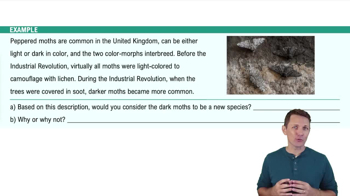
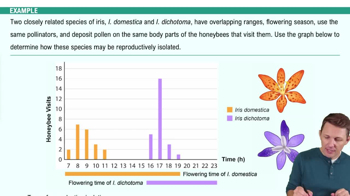
The Biological Species Concept Example 3
2481
views
16
rank
05:18
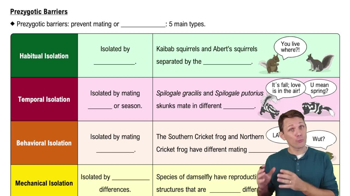
Prezygotic Barriers
2871
views
25
rank
01:27
The Biological Species Concept Example 1
2862
views
29
rank
Terms in this set (15)
Hide definitions
Biological Species Concept
A framework that groups organisms based on their inability to exchange genes due to reproductive isolation.
Reproductive Isolation
A condition where barriers prevent gene exchange between populations, maintaining distinct species.
Gene Flow
The movement of genetic material between populations, which increases similarity among them.
Prezygotic Barrier
A mechanism that prevents mating or fertilization from occurring between different populations.
Postzygotic Barrier
A mechanism that reduces the fitness or fertility of hybrids after fertilization has occurred.
Habitat Isolation
A situation where populations occupy different environments, preventing encounters and mating.
Temporal Isolation
A separation of populations due to differences in timing of mating seasons or daily activity.
Behavioral Isolation
A barrier where differences in courtship rituals or signals prevent recognition between potential mates.
Mechanical Isolation
A barrier caused by anatomical incompatibility, making successful mating physically impossible.
Gametic Isolation
A barrier where sperm and egg are biochemically incompatible, preventing fertilization.
Hybrid Viability
The ability of hybrid offspring to survive; reduced when hybrids are less likely to reach maturity.
Hybrid Sterility
A condition where hybrid offspring are healthy but unable to reproduce with parent species.
Hybrid Breakdown
A phenomenon where first-generation hybrids are fertile, but subsequent generations are weak or infertile.
Speciation
The evolutionary process by which populations become distinct species through reproductive isolation.
Zygote
A fertilized egg formed by the union of sperm and egg, marking the start of a new organism.
 BackBack
 02:15
02:15