Skip to main content
General Biology
My Course
Learn
Exam Prep
AI Tutor
Study Guides
Textbook Solutions
Flashcards
Explore
Try the app
My Course
Learn
Exam Prep
AI Tutor
Study Guides
Textbook Solutions
Flashcards
Explore
Try the app
Back
The Fossil Record definitions
You can tap to flip the card.
Fossil
You can tap to flip the card.
👆
Fossil
Preserved evidence of ancient life, which can include remains, imprints, or traces, not limited to hard parts like bones.
Track progress
Control buttons has been changed to "navigation" mode.
1/15
Related flashcards
Related practice
Recommended videos
The Fossil Record quiz #1
The Fossil Record
3 Terms
The Fossil Record quiz #2
The Fossil Record
25 Terms
The Fossil Record quiz #3
The Fossil Record
13 Terms
History of Life on Earth
24. History of Life on Earth
7 problems
Topic
Jason
24. History of Life on Earth
1 topic
3 problems
Chapter
Jason
03:17
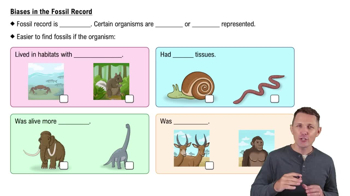
Biases in the Fossil Record
2419
views
19
rank
03:54
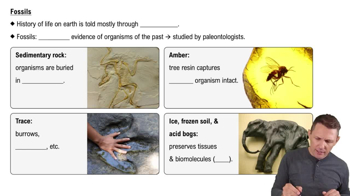
Fossils
2233
views
27
rank
02:59
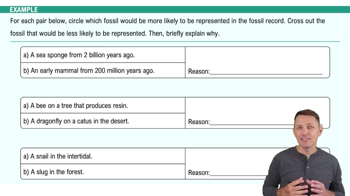
The Fossil Record Example 1
2035
views
16
rank
Terms in this set (15)
Hide definitions
Fossil
Preserved evidence of ancient life, which can include remains, imprints, or traces, not limited to hard parts like bones.
Sedimentary Rock
Layered material formed from compressed sediment, often the primary environment for the preservation of ancient remains.
Amber
Hardened tree resin capable of encapsulating and preserving entire small organisms, especially insects, in remarkable detail.
Trace Fossil
Indirect evidence of past life, such as footprints or burrows, revealing behavior or movement rather than physical form.
Paleontologist
A scientist specializing in the study and interpretation of ancient life through preserved remains and traces.
Fossil Record
The cumulative collection of preserved remains and traces, providing a timeline and context for the history of life.
Bias
A systematic distortion in preserved evidence, favoring certain environments, body types, or time periods over others.
Relative Dating
A method that estimates the age of remains based on their position within layered deposits, without assigning exact years.
Radiometric Dating
A technique using the predictable decay of radioactive isotopes to assign specific ages to ancient materials.
Isotope
A variant of a chemical element with a specific number of neutrons, some of which are unstable and decay over time.
Half-life
The time required for half of a radioactive substance to decay, serving as a clock for dating ancient materials.
Carbon-14
A radioactive form of carbon used to date organic remains up to about 60,000 years old by measuring its ratio to stable carbon.
Volcanic Ash
Material from eruptions that forms distinct layers, providing datable horizons for establishing the age of surrounding remains.
DNA
A biomolecule sometimes preserved in frozen or well-protected remains, enabling genetic analysis of ancient organisms.
Sedimentation
The process of particles settling and accumulating, creating environments favorable for the preservation of ancient life.
 BackBack
 03:17
03:17