Skip to main content
General Biology
My Course
Learn
Exam Prep
AI Tutor
Study Guides
Textbook Solutions
Flashcards
Explore
Try the app
My Course
Learn
Exam Prep
AI Tutor
Study Guides
Textbook Solutions
Flashcards
Explore
Try the app
Back
Carbon and Molecular Diversity of Life
You can tap to flip the card.
Why is carbon important in biological molecules?
You can tap to flip the card.
👆
Why is carbon important in biological molecules?
Carbon
forms the backbone of life because it can form four covalent bonds, allowing large, complex, and diverse molecules essential for living matter.
Track progress
Control buttons has been changed to "navigation" mode.
1/20
Recommended videos
Guided course
03:35
Carbon is an Excellent Building Block
18859
views
670
rank
Guided course
04:19
Carbon
25061
views
528
rank
2
comments
Terms in this set (20)
Hide definitions
Why is carbon important in biological molecules?
Carbon
forms the backbone of life because it can form four covalent bonds, allowing large, complex, and diverse molecules essential for living matter.
What defines organic chemistry?
The study of compounds containing
carbon
, typically with hydrogen, oxygen, nitrogen, and sulfur.
What is a hydrocarbon?
An organic molecule consisting only of
carbon and hydrogen
, often found in fats and fuels.
What are isomers?
Compounds with the same molecular formula but different structures and properties.
Name the three types of isomers.
Structural isomers
differ in covalent arrangements,
geometric isomers
differ in spatial arrangements, and
enantiomers
are mirror images.
Why are enantiomers important biologically?
They can have different effects in organisms; often only one enantiomer is biologically active.
What are functional groups?
Specific groups of atoms attached to carbon skeletons that determine the chemical properties of organic molecules.
List the seven important functional groups in biology.
Hydroxyl, Carbonyl, Carboxyl, Amino, Sulfhydryl, Phosphate, and Methyl groups.
What is the property of the hydroxyl group (-OH)?
Polar due to electronegative oxygen; forms hydrogen bonds; found in alcohols.
What defines the carbonyl group (>C=O)?
Sugars with ketone groups are ketoses; those with aldehydes are aldoses.
What is the role of the carboxyl group (-COOH)?
Acts as an acid by donating H+; found in carboxylic acids.
What is the function of the amino group (-NH2)?
Acts as a base by accepting H+; found in amines.
What is special about the sulfhydryl group (-SH)?
Can form cross-links that stabilize protein structure; found in thiols.
What does the phosphate group (-OPO3^2-) do?
Contributes negative charge; involved in energy transfer; found in organic phosphates.
How does the methyl group (-CH3) affect molecules?
Affects gene expression and hormone function; found in methylated compounds.
What shape do molecules with single carbon bonds have?
Tetrahedral shape due to four covalent bonds around carbon.
How does a double bond between carbons affect molecular shape?
Creates a flat shape in the molecule.
What is the difference between cis and trans geometric isomers?
Cis isomers have substituents on the same side; trans isomers have them on opposite sides.
Give an example of how enantiomers affect drug activity.
Ibuprofen's S-enantiomer reduces pain, while the R-enantiomer is ineffective.
Why can hydrocarbons release a large amount of energy?
Because their C-H bonds store energy that is released during reactions.
 BackBack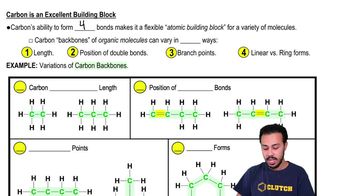
 03:35
03:35