 Back
BackCh 6-9 exam prep
 06:35
06:35
Terms in this set (34)
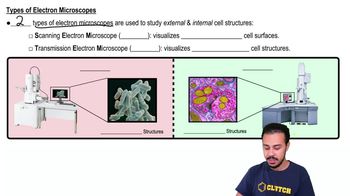
What kind of microscope looks at the outside of cells? What kind looks at insides of cells?
Scanning Electron Microscope (SEM)
Translating Electron Microscope (TEM)
What does Pro and Eu stand for in prokaryotic and eukaryotic? What does the suffix karyote mean?
Pro means first or before and Eu means good in terms of has.
Karyote referrs to neucleus.
What kind of ribosomes do proK and euK cells have? What does it refer to?
ProK cells have 70S ribosomes, and euK have 80S ribosomes.
The size.
Which cells are multicellular?
Eukaryotic cells. Also probably fungi cells and maybe some others I don't know yet.
Describe a ProK cell. Describe a EuK cell
A cell 1 micrometer or so long with no membrane bound organelles, 70S ribosomes, Circular DNA not bound by a nucleus, therefore in a nucleoid.
A cell around 100 micro meters long with membrane bound organelles, 70S ribos, linear DNA in a nucleus.
What is an organelle?
A part of a cell that performs a specific function for the life of the cell. (revise)
What domain do plants and animals belong to?
Eukaryotic.
Which organelles are shared by both plants and animals (generally)?
Mitchondria, Golgi apparatus, Rough and Smooth ER (endoplasmic reticulum), ribosomes, cell membranes, peroxisomes
What organelles are only found in animals?
Lysosomes
What organelles are only found in plants?
Chloroplast.
What is a ribosome and what do they do? What makes them different from other organelles? What are two options for ribosomes?
A ribosome is a non-membranous organelle that uses a process called Translation to build proteins from genetic material (mRNA). They can be free floating in the cytoplasm or attached to other organelles like endoplasmic reticulum
What is the endomembrane system? Which two functions do we focus on regarding the endomembrane system? What does endo- mean?
A group of membrane-bound organelles inside a euK cell. The organelles are bound by vesicles (little membrane bubbles).
Protein secretion and Cellular digestion.
Inside!
List some organelles in the endomembrane system?
Nuclear envelope, Endoplasmic reticulum, Golgi apparatus, transport vesicles.
Lysosomes & peroxisomes, vacuoles, and cell membrane.
What is protein secretion?
A process involving several different organelles in a specific order where proteins are released into the environment.
What is a nucleus? What are it's parts?
A rounded protective surface that holds most of a euK cells DNA
Nuclear envelope is the double membrane separates the inside and outside of the nucleus. Nuclear pores are tiny holes that allow entry and exit in and out of the nucleus. Nucleolus is the small dense structure where ribosomes are made.
What is the endoplasmic reticulum? What's its lumen?
They are membranous structures that are continuous with the cells nuclear envelope.
ER Lumen refers to the internal space of the ER.
What is a rough ER? What is a smooth ER?
Rough ER is the side closest to the nucleus where there are lots of ribosomes attached to it. Newly built proteins are folded and modified in the rER.
Smooth ER is the outer layer of ER with no ribosomes. The sER is associated with forming lipids and detoxifying drugs/poisons.
What is a vesicle?
A transport molecule that takes proteins and lipids from the nucleus to the Golgi apparatus.
What is the Golgi apparatus? What does it do?
A stack of cisternae (flat membranous sacs). (cristae?)
It functions as a processing center, receiving vesicles (kinda like packages), repurpose or modify, then repackage and send vesicles for export.
What are the ends of the Golgi apparatus called? What does it do with the cell membrane?
The cis end of the Golgi receives vesicles to be processed, the trans end exports vesicles.
Sometimes they (vesicles) are fused with cell membranes for the purpose of secretion.
In the endomembrane system, which two organelles are digestive in function?
Lysosomes and Peroxisomes.
What is a lysosome?
Lysosomes are fused to vesicles that are acidic in nature and they carry digestive enzymes that break down many things. They can recycle food, debris, bacteria, etc. Lysosomes are only found in animal cells and originate from the golgi apparatus.
What is a peroxisome?
A peroxisome is a vesicle that carries a digestive enzyme that breaks down toxins like H2O2, it also breaks down fatty acids. Peroxisomes are found in all euK cells, plants and animals alike, and originate from the rough ER.
What is a central vacuole? What cells is it found in?
Central vacuoles are large membrane enclosed vesicles. Central vacuoles have several diverse functions but primarily degrade and recycle molecules. It can also fill with water to exert turgor pressure on the cell wall to inflate the cell.
What are mitochondria? What important process does it perform? What makes this organelle different than most others?
Organelles that synthesis energy for the cell. ATP or adenosine triphosphate is made here.
Cellular respiration is the process of converting sugars and lipids to make ATP.
Mitochondria have their own independent DNA.
List the elements of mitochondrial structure. What is in the mitochondrial matrix?
Outer membrane, Inner membrane that includes cistae (folds), intermembrane (the space between outer and inner).
The matrix is inside the inner membrane and contains mitochondrial DNA, ribosomes, enzymes
What are chloroplasts? What is photosynthesis?
Chloroplasts are green organelles that function as the site of the function photosynthesis.
A cellular process that uses sunlight to synthesize sugars (glucose). It converts CO2 and water and sunlight into glucose and oxygen gas.
Describe the structure of a chloroplast.
Chloroplasts have inner and outer membranes (no cristae (folds)), Thylakoids (disc shaped structures) hollow interconnected sacs, Grana/granum (stacks of thylakoids), Stroma (the innermost region where enzymes, ribosomes, and chloroplast DNA live).
What is endosymbiotic theory?
The theory that chloroplasts and mitochondria were once independently living cells 1.5bya. An aerobic cell (uses oxygen in its metabolism) was engulfed by an anaerobic cell and began a symbiotic relationship.
What is some of the supporting evidence for endosymbiotic theory?
There are similarities between proK cells and mitochondria and chloroplasts including, sharking 70S ribosomes, small circular DNA, and replication by binariy fission. Mito' and Chloro' also have two membranes, inner and outer, which is consistent with the idea of engulfment.
What is the cytoskeleton? What does it do?
A network of elongated protein structures within the cytoplasm with multiple functions.
Some functions include, providing shape, structure, movement, and can also be involved with transporting molecules within the cells, it can also be involved in biosignaling.
What are the three major components of the cytoskeleton? What do they do?
Microfilaments are small rods that are usually made of thin rods of repeating actin proteins.
Intermediate filaments vary in size and can be made of variable proteins
Microtubules are the largest in size and form cylindrical tubes made of tubulin proteins.
What are cilia and flagella?
Both are primarily made from microtubules and provide movement for the cell or to move objects (in the case of cilia). Cilia are lots of short hair like structures that move like oars. Flagella are long tail like structures that move like whips.
What are the four types of cell junctions?
Tight, membrane proteins that form leakproof barriers between linked cells.
Anchoring junctions (desmosomes) intermediate filiaments that anchor cells together.
Gap, protein channels that connect the two cytoplasms between cells.
Plasmodesmata, gaps in plant cell walls. (similar to gap junctions)