 Back
BackDNA Synthesis & Repair - General Biology
 05:10
05:10
Terms in this set (24)
Each new DNA molecule consists of one old (parent) strand and one newly synthesized strand, proven by the Meselson-Stahl experiment.
Generation 1 showed a hybrid band, ruling out conservative replication; Generation 2 showed hybrid and light bands, ruling out dispersive replication.
DNA strands are antiparallel; synthesis occurs only 5′→3′ by adding nucleotides to the 3′-OH end.
Continuous synthesis toward the replication fork, requiring one RNA primer and extended by DNA polymerase III.
Discontinuous synthesis away from the fork, made in Okazaki fragments each started by RNA primers and later joined.
Short DNA segments synthesized discontinuously on the lagging strand, later joined by DNA ligase.
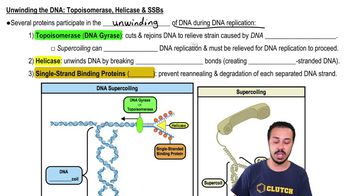
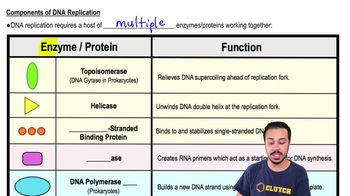
Unwinds and separates the two DNA strands at the replication fork to open the double helix.
Synthesizes short RNA primers providing the 3′-OH group needed for DNA polymerase to start synthesis.
Main enzyme that adds dNTPs 5′→3′ to extend the new DNA strand from the RNA primer.
Removes RNA primers and replaces them with DNA nucleotides.
Seals nicks in the sugar-phosphate backbone, joining Okazaki fragments into a continuous strand.
Relieves supercoiling tension ahead of the replication fork by cutting and resealing DNA strands.
Bind and stabilize separated single DNA strands to prevent reannealing or hairpin formation.
On the lagging strand, removal of the final RNA primer leaves a gap that DNA polymerase cannot fill, causing chromosome shortening.
Repetitive, gene-free DNA sequences at chromosome ends that protect coding regions from shortening.
Extends telomeres using its own RNA template, preventing chromosome shortening in germ and cancer cells.
DNA polymerase’s ε subunit removes incorrectly paired bases immediately during synthesis, reducing errors.
Detects and corrects mismatches missed by proofreading after DNA synthesis is complete.
Removes bulky DNA damage like thymine dimers caused by UV light, then fills and seals the gap.
UV-induced covalent bond between adjacent thymines that distorts DNA and blocks replication and transcription.
dNTPs provide energy by cleaving two phosphates as pyrophosphate, which is hydrolyzed to drive polymerization.
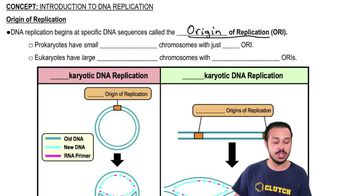
Specific DNA sequence where replication begins; bacteria have one, eukaryotes have many.
Region of unwound DNA with two Y-shaped replication forks moving bidirectionally.
Holds DNA polymerase onto the DNA template, increasing processivity and speed of synthesis.