 Back
BackEnergy and Metabolism in General Biology
 02:17
02:17
Terms in this set (20)
Thermodynamics is the branch of chemistry concerned with energy changes in physical and chemical processes.
Potential energy is stored energy; kinetic energy is energy of motion.
Energy is neither created nor destroyed; it only changes form.
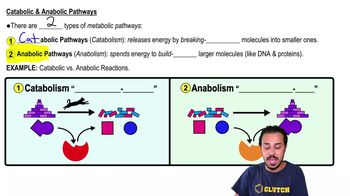
Anabolic reactions build larger molecules and are endergonic. Catabolic reactions break down molecules and are exergonic.
Activation energy is the energy required to start a chemical reaction.
Catalysts lower the activation energy needed for a reaction, speeding it up without being consumed.
ATP consists of adenine, ribose sugar, and three phosphate groups linked by high-energy bonds.
ATP's phosphate bonds are unstable, so cells store energy in fats and carbohydrates instead.
ATP hydrolysis releases energy that drives endergonic reactions.
Enzymes are mostly proteins that act as biological catalysts to speed up reactions by stabilizing substrate binding.
Increasing enzyme or substrate concentration generally increases the rate of enzyme-catalyzed reactions.
Enzyme activity depends on optimum temperature and pH; deviations can reduce activity by altering enzyme shape.
A competitive inhibitor binds to the enzyme's active site, blocking substrate binding.
A noncompetitive inhibitor binds to a different site, causing enzyme shape change and preventing substrate binding.
Allosteric enzymes have active and inactive forms regulated by molecules binding to allosteric sites.
Feedback inhibition occurs when the end product of a pathway binds an enzyme allosterically to shut down the pathway and conserve resources.
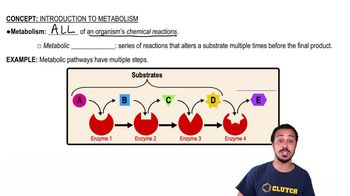
Biochemical pathways are sequences of reactions where each product is the substrate for the next, often compartmentalized in organelles.
Enzymes catalyze each step in a pathway, ensuring efficient and regulated metabolic flow.
Enzymes have an optimum temperature; activity decreases if temperature is too low or too high.
Each enzyme has an optimum pH; activity drops if pH deviates from this optimum.