 Back
BackEnergy, Metabolism, and Enzymes in General Biology
 04:21
04:21
Terms in this set (20)
Metabolism is the sum of all chemical reactions in a biological system, including anabolic and catabolic pathways.
Anabolic pathways build complex molecules from simple ones (e.g., synthesis of proteins). Catabolic pathways break down complex molecules into simpler ones, releasing energy (e.g., cellular respiration).
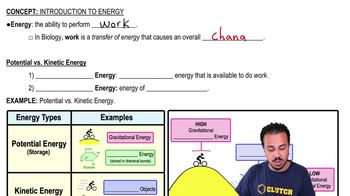
Kinetic energy is energy of motion; Potential energy is stored energy; Chemical energy is potential energy stored in chemical bonds, such as in ATP.
ATP stores chemical energy in its phosphate bonds and drives biological reactions by transferring a phosphate group, releasing energy.
ATP is regenerated by adding a phosphate group to ADP through cellular respiration or photosynthesis, restoring its energy storage capacity.
Enzymes are proteins that speed up chemical reactions by lowering activation energy. They bind substrates at the active site, forming an enzyme-substrate complex.
Enzymes have a specific 3D structure and active site shape that fits only certain substrates, based on protein folding and R group interactions.
Cofactors (inorganic ions) and coenzymes (organic molecules) assist enzymes by stabilizing substrate binding or participating in reactions.
Competitive inhibitors bind to the enzyme's active site, blocking substrate binding and reducing enzyme activity.
Non-competitive inhibitors bind to an allosteric site, changing enzyme shape and reducing activity without blocking substrate binding.
Yes, by increasing substrate concentration, which outcompetes the inhibitor for the active site.
No, because the inhibitor changes enzyme shape regardless of substrate concentration.
Feedback inhibition occurs when the end product of a pathway binds an enzyme allosterically to stop the pathway, regulating cell metabolism.
Denaturation disrupts protein structure, especially tertiary and quaternary levels, causing loss of enzyme function.
Temperature, pH, and chemical environment can alter enzyme structure and function by affecting protein folding and stability.
Enzymes have an optimal temperature where activity is highest; above or below this, activity decreases due to denaturation or reduced kinetic energy.
Pepsin works best in acidic pH (~2) in the stomach; trypsin works best in basic pH (~8) in the small intestine.
Beta-amyloid peptides aggregate into plaques in the brain, disrupting neuron function and contributing to Alzheimer's disease.
Enzyme: beta-secretase (BACE1); Substrate: amyloid precursor protein (APP); Product: beta-amyloid peptide. All are proteins or peptides.
A competitive inhibitor drug must structurally resemble the substrate to bind the enzyme's active site and block substrate binding.